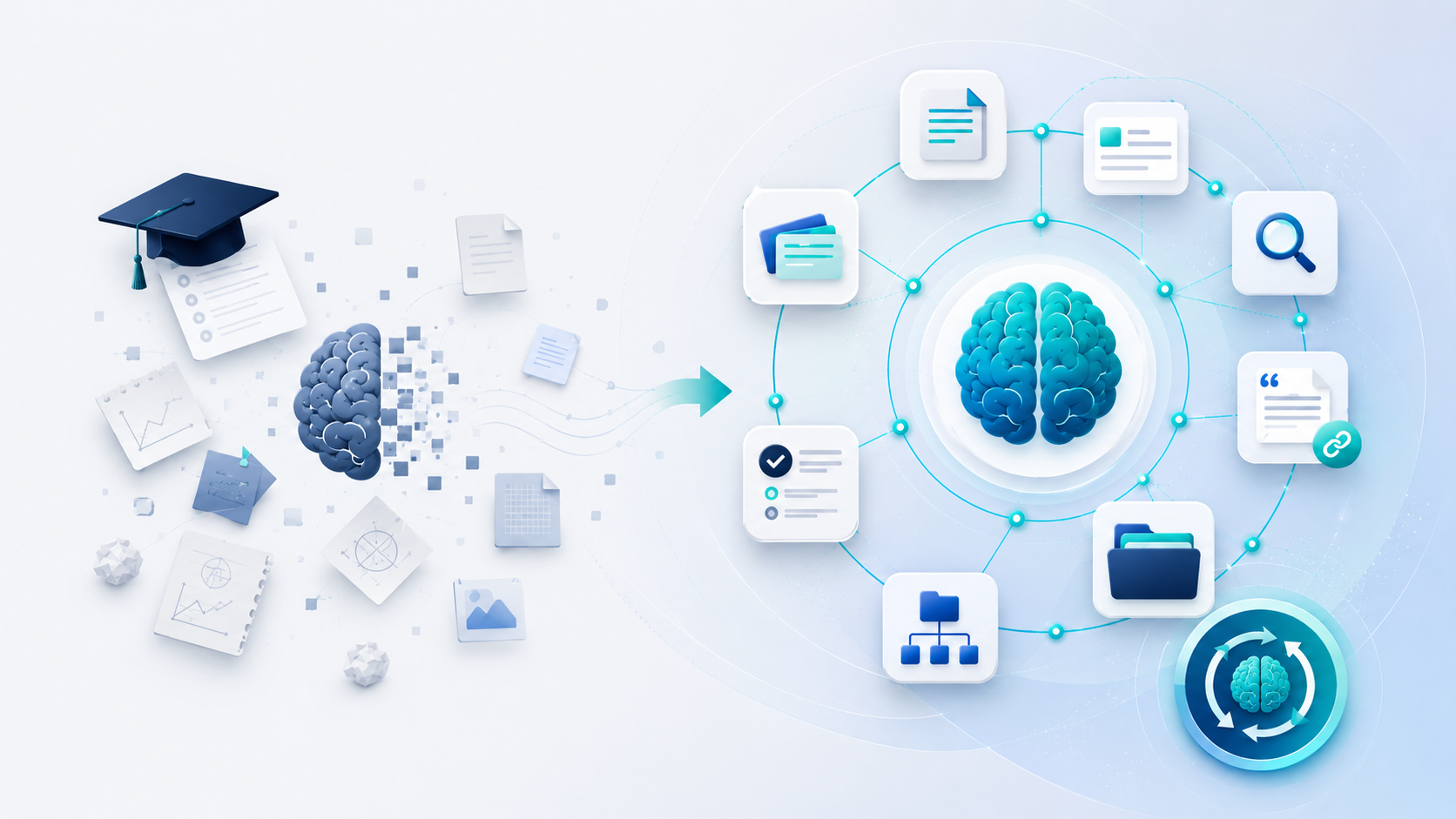


The AI study-tool market is crowded. The learning models are not.
The best AI study tools in 2026 can all generate notes, summaries, flashcards, quizzes and AI-powered explanations. However, important differences emerge in how these platforms organise learning, connect answers to original sources, support active revision and help students retain knowledge throughout an academic course.
The meaningful differences become clearer when you ask a more practical question:
What happens after the first summary is generated?
Does the platform help you interrogate and verify your sources? Does it organise an entire academic module, or create a separate session for each upload? Does it make revision feel like a game? Can it guide a spoken tutoring session? Does it help an institution control how AI is used?
Most importantly, does it help knowledge remain accessible when the exam arrives?
This comparison looks at:
- LRND
- Gizmo
- StudyFetch
- Gemini Notebook, formerly NotebookLM
- YouLearn
- Mindgrasp
The quick verdict
| Platform | Best for | Strongest emphasis | What sets it apart |
|---|---|---|---|
| LRND | Students and institutions building a connected learning system | Module-based knowledge organisation, cited AI support and active revision | Combines a long-term “second brain” model with retention workflows and institution-level deployment options |
| Gizmo | Students motivated by games, streaks and fast recall | Gamified quizzes, AI flashcards, spaced repetition and social challenges | Makes memorisation feel light, social and habit-forming |
| StudyFetch | Students wanting a broad collection of tools in one product | AI tutoring, planning, live lectures, voice, videos, games and practice tests | Offers multiple ways to interact with the same course material |
| Gemini Notebook, formerly NotebookLM | Researching and making sense of a collection of sources | Source-cited answers, notebooks and audio-led exploration | Strong source exploration and podcast-style Audio Overviews within Google’s ecosystem |
| YouLearn | Conversational learning from mixed-media content | AI tutoring, voice, references, quizzes, podcasts and personalised exams | Provides a clean, tutor-led experience across several content formats |
| Mindgrasp | Turning a lecture, chapter or topic into a study session quickly | Notes, summaries, flashcards, quizzes and an AI tutor | Fast session creation, live recording and a straightforward content-conversion workflow |
Overall comparison
There is no single best AI study platform for every learner.
Gizmo is particularly useful when motivation and rapid recall are the main challenges. Gemini Notebook is compelling for source exploration and research. StudyFetch offers exceptional feature breadth. YouLearn and Mindgrasp make it quick to transform learning content into an interactive study experience.
LRND’s clearest advantage is its combination of:
- Module-based knowledge management
- Source-grounded learning
- Active revision
- Long-term knowledge retrieval
- Institutional control
The right choice therefore depends not only on which features a platform offers, but also on how it organises the learning journey.
How were the AI study platforms compared?
Rather than simply counting features, this comparison uses six questions that matter during a real academic semester:
- How easily can a student add lectures, PDFs, slides, links, videos and audio recordings?
- Can the AI explain the material while keeping its answers connected to the original sources?
- Does the platform support retrieval practice through flashcards, quizzes or exams?
- How does it organise knowledge: by deck, notebook, space, study session or academic module?
- Does it support a repeated learning journey rather than only producing one-off outputs?
- Can universities and learning providers introduce it with appropriate governance, integration and deployment controls?
1. Learnd.Ai
Best for building a long-term, module-based learning system
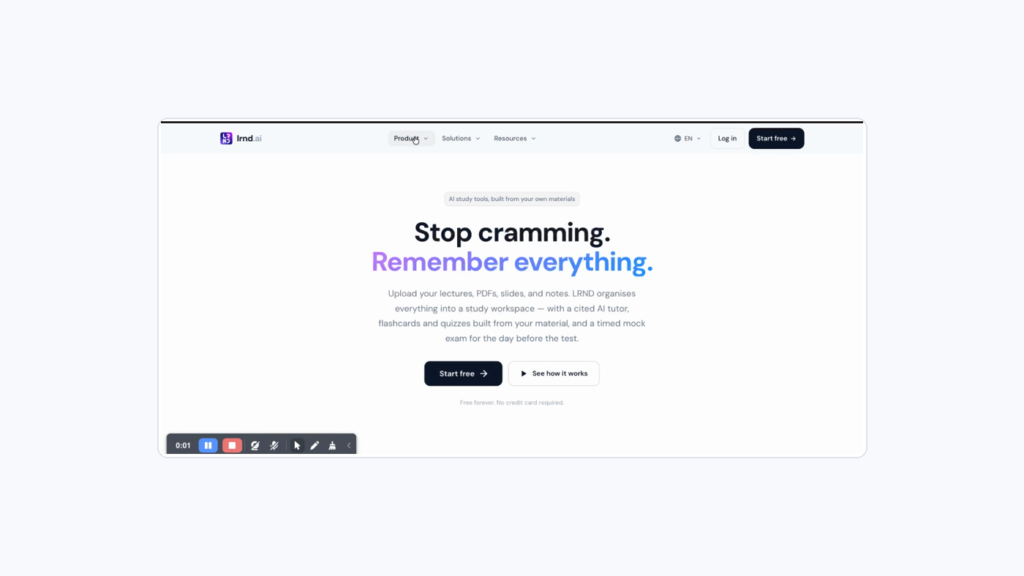
Learnd.Ai begins with a different organising principle: students should not have to rebuild their study environment every time they open a new file.
Lectures, slides, recordings, PDFs, links and personal notes can be grouped inside academic modules. Students can then reuse the same source material for understanding concepts, revising actively and preparing for assessments.
That distinction matters because basic AI-generated outputs are no longer rare. Several platforms in this comparison can create flashcards, summaries and quizzes.
Learnd.Ai’s stronger proposition is that these outputs remain connected to a structured knowledge environment that grows across a subject. The platform is positioned less as a one-off content generator and more as an AI learning workspace.
A student can use Learnd.Ai’s cited AI tutor to clarify a difficult concept from their own materials, move into AI-generated flashcards and quizzes, and later create a timed mock exam from the same module.
The original source material does not disappear after an answer is produced. It remains searchable and available for future revision sessions.
A realistic Learnd.Ai workflow
- Create a module for a course such as Cognitive Psychology.
- Add lecture recordings, presentation slides, required reading and personal notes.
- Ask a question and check the cited page, section or timestamp behind the answer.
- Generate active-recall questions and flashcards from the same material.
- Return later to revise weaker areas instead of beginning another disconnected AI conversation.
- Build a module-level mock exam when assessment preparation begins.
This is where Learnd.Ai’s student “second brain” positioning becomes meaningful.
The goal is not simply to save files. It is to preserve the relationship between sources, explanations and practice activities so that previous learning can be retrieved and reused.
What is Learnd.Ai’s clearest USP?
Learnd.Ai does not own flashcards, quizzes, AI chat or source grounding individually. Its differentiation comes from the way these elements are combined.
- Module-based: Course materials are structured around the way university learning is actually delivered.
- Knowledge that accumulates: The workspace grows across lectures and subjects instead of resetting after every task.
- Retention-led progression: Students move from explanation to active recall, repeated practice and assessment preparation.
- Source traceability: Answers can be checked against the material being studied.
- Student and institutional fit: The same learning model can be offered with customisation, guardrails, dedicated deployment and implementation support for universities and learning providers.
For individual learners, Learnd.Ai works as an AI study platform, knowledge-management workspace and exam-revision system.
For universities, academies and training providers, its institutional proposition adds governance, customisation and deployment options.
2. Gizmo
Best for gamified flashcards, active recall and daily study motivation
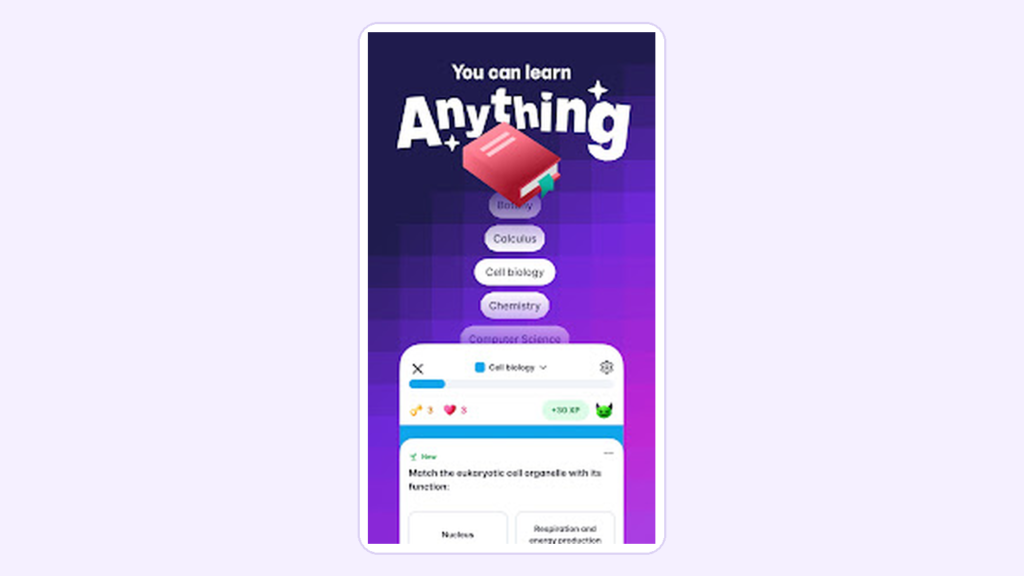
Gizmo is the most obviously game-like platform in this comparison.
Its public promise is straightforward: AI quizzes that make studying easier. Students can import material from PDFs, notes, PowerPoint presentations, YouTube, Quizlet and Anki, convert it into flashcards and practise through short quizzes.
Rewards, leaderboards, hearts and shared challenges are used to make the revision process feel more engaging.
That focus is a genuine strength.
Many students do not need another elaborate productivity environment. They need a reason to begin revising and a system that repeatedly asks them to retrieve information.
Gizmo makes that retrieval loop visible and rewarding. It is particularly well suited to:
- Fact-heavy subjects
- Vocabulary learning
- Definitions
- Terminology
- Exam content that can be divided into clear questions and answers
Where Gizmo stands out
- Approachable, mobile-first revision experience
- Strong use of active recall and spaced repetition
- Gamification through hearts, rewards and leaderboards
- Study games and shared challenges
- Easy importing and scanning of existing notes
- Public and shared decks that reduce the work required to start studying
The trade-off is focus.
Gizmo is primarily a deck-and-quiz environment. It can organise files and decks, but its strongest public identity is memorisation and motivation rather than maintaining a connected academic knowledge base across an entire university module.
Compared with Learnd.Ai, Gizmo is likely to feel more playful and immediately habit-forming.
Learnd.Ai may be a better fit when the learner also needs source-grounded explanations, cross-resource organisation, module continuity and one environment that supports the journey from lectures to mock exams.
A student could reasonably use Gizmo for rapid recall while using Learnd.Ai as the wider academic knowledge system.
3. StudyFetch
Best for students who want a broad all-in-one feature set
StudyFetch has one of the broadest publicly advertised feature sets in the AI study-tool category.
Its Spark.E tutor can answer questions from uploaded coursework through chat or voice. Tutor Me guides students through material at their own pace, while Live Lecture captures notes in real time.
Study Plan builds a schedule around upcoming deadlines, and Arcade turns course content into game-style study challenges.
StudyFetch’s testing options are also extensive. Students can generate:
- Flashcards
- Quizzes
- Exam-specific questions
- Full practice tests
- Audio recaps
- Explainer videos
- Visual learning resources
Its plugins and mini apps may appeal to students who enjoy varying study formats rather than following a single fixed revision method.
Where StudyFetch stands out
- Broad coverage across organisation, tutoring, content generation, testing and games
- Voice conversations with an AI tutor
- AI-generated visual and video explanations
- Live-lecture recording and automatic note creation
- Personalised study planning based on materials and deadlines
- Institutional pathways for schools and universities
- Multiple ways to revisit the same learning content
StudyFetch has also added a Spaced Learning Hub and guided chat experiences. It should therefore not be described as merely a content generator.
Its product direction increasingly connects planning, tutoring and repeated practice.
The comparison with LRND comes down to emphasis rather than a missing checklist item.
StudyFetch’s advantage is breadth and variety. Learnd.Ai’s advantage is a more focused story around the academic module as the permanent container for learning.
Learnd.Ai also places greater emphasis on:
- Knowledge accumulating over time
- Source traceability
- Connections between learning and revision assets
- Institution-specific AI behaviour
- Deployment and governance options
Students who want the greatest number of interactive formats may favour StudyFetch.
Institutions that want a knowledge management and retention layer integrated with their existing educational content may find the Learnd.Ai model clearer.
4. Gemini Notebook, formerly NotebookLM
Best for source-grounded exploration, research and audio overviews
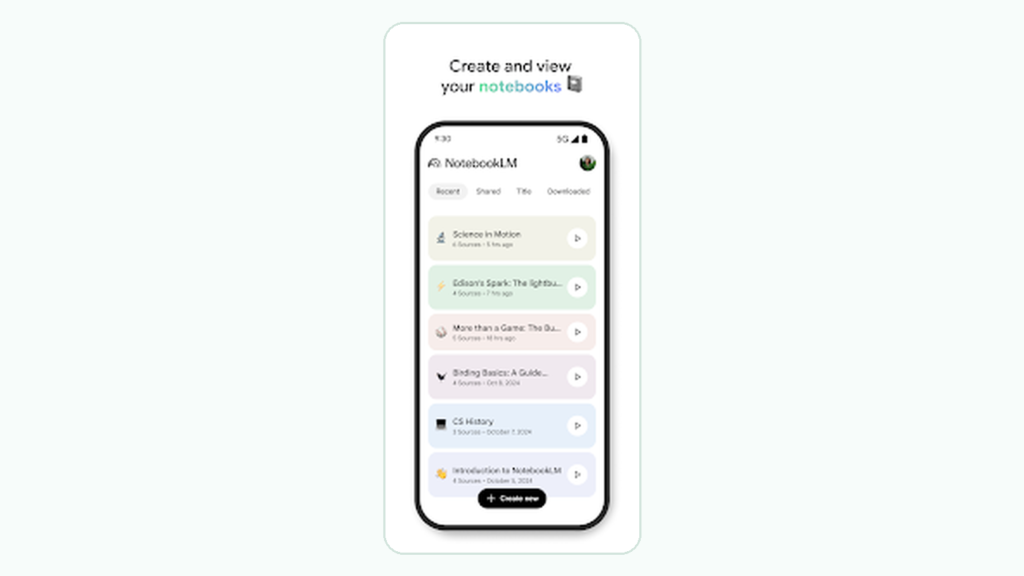
Gemini Notebook, formerly known as NotebookLM, is Google’s source-centred research and learning tool.
A user creates a notebook, adds sources such as PDFs, websites, YouTube videos or text, and asks questions that are answered using those sources.
One of its defining features is Audio Overviews: podcast-style conversations generated from the materials added to a notebook.
The platform goes beyond basic summarisation. It can help learners:
- Compare readings
- Identify themes across several documents
- Create study guides
- Revisit a source collection in audio form
- Generate flashcards and quizzes
- Maintain context across longer conversations
- Save and return to previous chats
Where Gemini Notebook stands out
- Source-grounded question answering with inline citations
- Audio Overviews that make dense source collections easier to revisit
- Notebook-based organisation for research projects and reading lists
- Integration with Google’s wider ecosystem
- Useful study outputs, including quizzes and flashcards
- Strong support for comparing and synthesising several sources
For a dissertation chapter, literature review or complex reading pack, Gemini Notebook may be the most natural first choice.
It is particularly useful when a learner needs to understand what several sources say collectively.
Learnd.Ai overlaps with Gemini Notebook in source-grounded chat, but the two platforms have different centres of gravity.
Gemini Notebook begins with a source collection and research exploration.
LRND begins with the learning journey across an academic module:
- Organise the materials.
- Understand the content.
- Practise retrieval.
- Prepare for an assessment.
- Retain the knowledge for future use.
Learnd.Ai also has a more explicit institutional proposition around academic workflows, guardrails, custom deployment and branded learning environments.
Gemini Notebook is a powerful research companion. LRND aims to function as a continuing learning system.
5. YouLearn
Best for conversational tutoring with flexible media and exam practice
YouLearn presents itself as an AI tutor that understands PDFs, YouTube videos and recorded lectures.
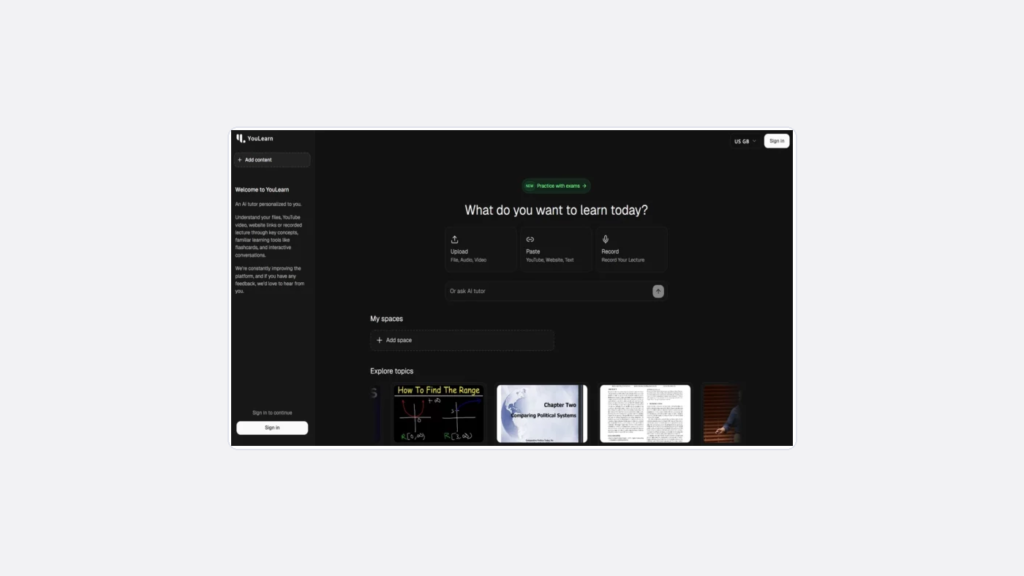
Students can upload learning content, create notes and summaries, ask questions, generate quizzes or podcasts, and receive answers with references.
The platform also supports:
- Personalised exams
- Answer breakdowns
- Progress tracking
- Spoken interaction with the AI tutor
- Mixed-media learning materials
The experience is intentionally straightforward.
A learner can upload or record content, enter a space and begin a tutoring conversation without first designing a complex knowledge-management system.
This makes YouLearn appealing to students who value a clean interface and want the AI tutor to guide the interaction.
Where YouLearn stands out
- Clear tutor-led experience
- Support for PDFs, YouTube, audio, video and recorded lectures
- Answers with references
- Spoken conversations with the AI tutor
- Quizzes and podcasts generated from uploaded content
- Personalised exams
- Spaces for grouping related learning materials
YouLearn and LRND both support mixed media, source-aware answers and assessment practice.
The difference lies primarily in the organising promise.
YouLearn is positioned around the personal tutor and the interaction between the learner and their content.
LRND places greater emphasis on the module as a growing knowledge hub, the connection between source material and revision assets, and the ability to retain that system throughout an entire course.
LRND also speaks more directly to institutional implementation, governance and custom deployment.
6. Mindgrasp
Best for turning a lecture, chapter or topic into a study session quickly
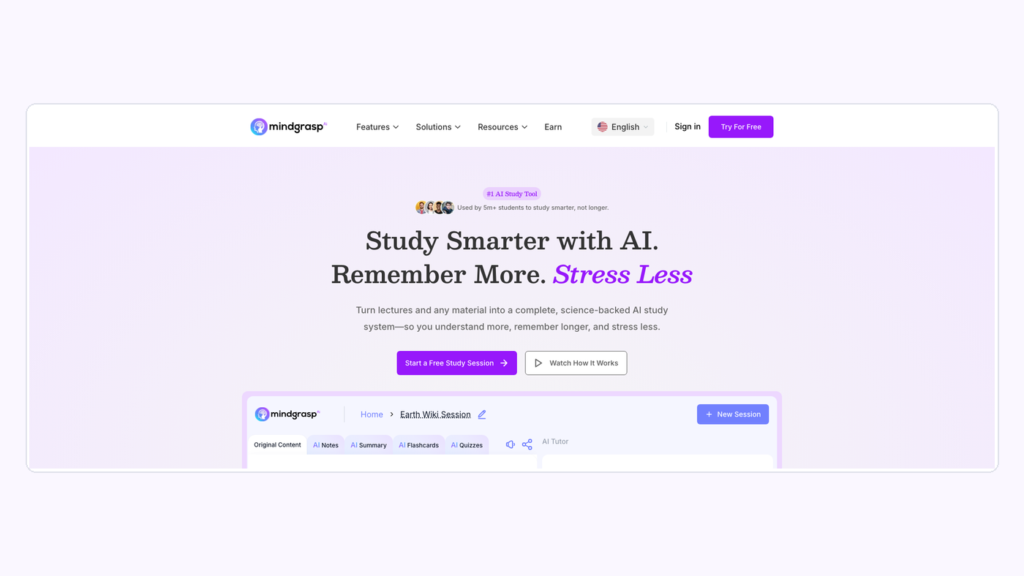
Mindgrasp turns lectures, readings, links and uploaded files into a bundled study session containing:
- Notes
- A summary
- Flashcards
- Quizzes
- Access to an AI tutor
It supports live lecture recording as well as PDFs, slides, web links, YouTube videos, audio recordings and digital book files.
The workflow is easy to understand:
- Create a study session.
- Add the learning material.
- Allow the AI to process it.
- Review the generated resources.
- Practise and ask questions.
Mindgrasp recommends creating one session for each lecture, chapter or exam topic.
It also offers an iOS app and a Chrome extension that can help users bring content in from learning platforms and websites.
Where Mindgrasp stands out
- Fast conversion of one content set into a complete collection of study materials
- Live lecture recording
- Broad file-format support
- Simple session-based structure
- Notes, summaries, flashcards and quizzes in one session
- AI tutor access
- Browser-extension and learning-platform compatibility
Mindgrasp’s messaging includes active recall, practice testing and longer-term memory, so it should not be reduced to a summarisation tool.
Its practical strength is rapid session creation.
LRND’s distinction is architectural.
Mindgrasp recommends one study session for each lecture, chapter or topic. LRND groups multiple lectures and sources inside a wider academic module and treats the resulting knowledge as cumulative.
A student who wants instant materials from today’s lecture may prefer Mindgrasp’s directness.
A student or institution trying to build a durable, source-grounded learning environment across a complete course may prefer LRND’s module-based and second-brain model.
Head-to-head: which AI study tool performs best?
Best for source-grounded research
Gemini Notebook is the clearest specialist for interrogating and synthesising a collection of sources.
YouLearn also provides references, while LRND centres cited answers within an academic module.
StudyFetch and Mindgrasp train their tutors on uploaded learning materials, but citations are less central to their public headline positioning.
For a literature-heavy research task, Gemini Notebook has the edge.
For source-grounded learning followed by structured revision, LRND offers a more complete progression.
Best for gamification and motivation
Gizmo is the strongest choice when the main obstacle is getting a student to practise consistently.
Its rewards, hearts, leaderboards, games and social challenges make the recall loop feel immediate.
StudyFetch’s Arcade also introduces game-based study, although gamification is only one part of its wider platform.
LRND is calmer and more academic in tone. Its value lies in continuity, organisation and confidence rather than game mechanics.
Best for the widest collection of AI study tools
StudyFetch leads on visible feature breadth.
Voice tutoring, live lecture capture, study planning, audio recaps, explainer videos, visuals, plugins, games, flashcards and multiple testing formats give students many ways to approach the same topic.
Mindgrasp also provides an efficient all-in-one study-session bundle.
LRND is broad enough to cover the core learning journey, but its differentiation should not be presented as having the longest list of features.
Best for a simple AI tutor conversation
YouLearn provides one of the clearest tutor-led propositions, combining uploads, voice, references, quizzes and exams within a straightforward interface.
StudyFetch offers more formats and modes around its tutor, while Gemini Notebook is more research-notebook oriented.
LRND’s tutor is most compelling when a conversation needs to remain connected to a structured academic module and feed into future revision resources.
Best for long-term knowledge organisation
This is the category LRND should aim to own.
Gizmo organises decks. Gemini Notebook organises source notebooks. YouLearn uses spaces, while Mindgrasp uses study sessions.
Each structure has value.
LRND’s more specific proposition is to organise a learner’s complete materials by module and keep the resulting knowledge available across:
- Explanation
- Active recall
- Revision
- Assessment preparation
- Long-term retrieval
The advantage is not storage alone. It is the continuity between different stages of learning.
Best for institutions and responsible AI adoption
StudyFetch has a clear institutional and enterprise offering, while Gemini Notebook operates within Google’s wider education and workplace ecosystem.
LRND’s institutional proposition is particularly central to its brand.
It includes:
- Source traceability
- Institution-specific AI configuration
- Academic guardrails
- Branded and white-labelled learning environments
- Integration with existing platforms
- Dedicated deployment options
- Implementation support
For a university buyer, this moves the comparison beyond student-facing features and into governance, implementation and compatibility with existing institutional content.
AI study-tool comparison matrix
| Platform | Organisation model | Main learning strengths | Institutional positioning |
| LRND | Academic modules and a connected knowledge workspace | Cited tutor, flashcards, quizzes, mock exams, active recall and long-term retrieval | Core part of the offer, including customisation, guardrails, integration and deployment options |
| Gizmo | Files and flashcard decks | Gamified recall, spaced repetition, quizzes, social study and public decks | Primarily learner-facing in its public positioning |
| StudyFetch | Course materials, plans and feature hubs | Tutoring, voice, lecture capture, games, videos, flashcards and tests | Dedicated teacher and institutional pathways |
| Gemini Notebook, formerly NotebookLM | Source notebooks | Source synthesis, inline citations, Audio Overviews, flashcards and quizzes | Available through Google’s education and workplace ecosystem |
| YouLearn | Content spaces | Conversational tutoring, references, podcasts, quizzes and personalised exams | Public positioning is primarily focused on individual learners |
| Mindgrasp | Study sessions organised by lecture, chapter or topic | Notes, summaries, flashcards, quizzes, live recording and AI tutoring | Used within education, although governance is less central to its public messaging |
Which AI study tool should you choose?
Choose LRND if:
You want one module-based environment for organising course materials, asking cited questions, revising actively and preparing for exams.
LRND is also worth considering when evaluating a governed AI learning environment for a university, academy or training provider.
Choose Gizmo if:
You learn best through short, game-like recall sessions and need motivation, streaks or social competition to study consistently.
Choose StudyFetch if:
You want a wide collection of tutoring, planning, voice, lecture, game, video and testing features within one account.
Choose Gemini Notebook if:
Your main task is understanding, comparing and revisiting a collection of sources, particularly through cited chat and Audio Overviews.
Choose YouLearn if:
You want a simple personal-tutor experience with voice, references, quizzes, podcasts and personalised exams.
Choose Mindgrasp if:
You want to record or upload a lecture and quickly receive a complete study session without first building a larger workspace.
These tools are not necessarily mutually exclusive.
A student might use Gemini Notebook to explore a research pack, Gizmo for rapid vocabulary practice and LRND to preserve their wider course knowledge system.
The right primary platform is the one whose organising model matches the way the student needs to learn week after week.
Why LRND’s USP is more than AI flashcards and quizzes
The weakest way to position LRND would be to say that it turns content into summaries, flashcards and quizzes.
Almost every major platform in this comparison makes a similar promise.
The stronger position is that LRND turns scattered learning materials into a persistent learning system.
Consider two students taking the same six-week module.
The first student uploads each lecture to a general AI study tool, generates a summary, completes a quiz and moves on. By week six, they have six separate study sessions and several disconnected outputs.
The second student keeps every lecture, reading, slide deck and recording inside one academic module.
Questions, explanations, flashcards and assessments are created from that shared context. When revision begins, the structure of the course is already available.
That second journey expresses LRND’s real differentiation.
It begins with organisation
Learning materials are not treated as disposable inputs. They remain organised and available for future use.
It connects understanding with retrieval
An explanation can lead naturally into active-recall questions, flashcards, quizzes and a mock exam.
It keeps the source visible
Students can check where an answer originated rather than accepting an isolated AI response.
It follows the academic module
The platform mirrors an academic structure that students and institutions already understand.
It can continue beyond one exam
The knowledge hub is designed to remain searchable and reusable after an individual assessment has finished.
It gives institutions control
The AI environment can be configured around institutional content, policies, branding, integrations and deployment requirements.
This is also why LRND’s learning-science content should remain connected to its product pages.
Resources covering active recall, passive revision, forgetting and long-term retention explain the learning behaviours that the workspace is designed to support.
Final verdict
The AI study-tool market has moved beyond simple summarisation.
Gizmo makes recall engaging. StudyFetch gives students a wide range of study modes. Gemini Notebook makes collections of sources easier to understand, compare and revisit through audio.
YouLearn provides a clean personal-tutor experience, while Mindgrasp turns individual lectures into complete study sessions with very little setup.
LRND should not claim that these platforms cannot help students remember information. Several now use active recall, quizzes, spaced learning and practice testing.
Its defensible advantage is the combination of four elements within one learning model:
- A module-based knowledge hub
- Source-grounded AI support
- A progression from understanding to repeated retrieval
- An institution-ready approach to governance and deployment
The comparison is therefore not simply about which platform creates the fastest set of flashcards.
It is about whether a learner needs a deck, an AI tutor, a research notebook, an individual study session or a knowledge system that remains useful throughout an entire course.
Build a learning system, not another folder of AI outputs
Explore how LRND organises lectures, PDFs, recordings and notes into cited explanations, active-recall practice and assessment preparation.
Explore the LRND AI study platform
See LRND for institutions
Sources and further reading
This comparison was researched using the live company websites and official application listings for the platforms covered.
- LRND — AI study platform and knowledge-management workspace
- LRND — For Institutions
- Gizmo — Official website and app information
- StudyFetch — Official website
- Gemini Notebook, formerly NotebookLM — Official Google product information
- YouLearn — Official website
- Mindgrasp — Official website