
A familiar pattern appears at universities every year. Students spend weeks revising, complete an exam, feel an immediate sense of relief and then realise a few months later that much of the material has become difficult to recall. The notes still exist. The grade is recorded. Yet the knowledge that once felt intensely familiar seems to have disappeared.
This is not evidence that the student failed to learn anything. It is a predictable result of how memory works and how assessment shapes behaviour. Information that is used briefly and then abandoned becomes harder to retrieve. The bigger problem is structural: university learning is often organised around passing the next assessment rather than preserving knowledge for later use.
Forgetting is normal, but it is not inevitable
Memory is not a permanent recording. It changes with time, interference and use. When a student stops retrieving an idea after an exam, access to that idea generally becomes weaker. This does not always mean the memory has been erased. Often, the route back to it has become less available.
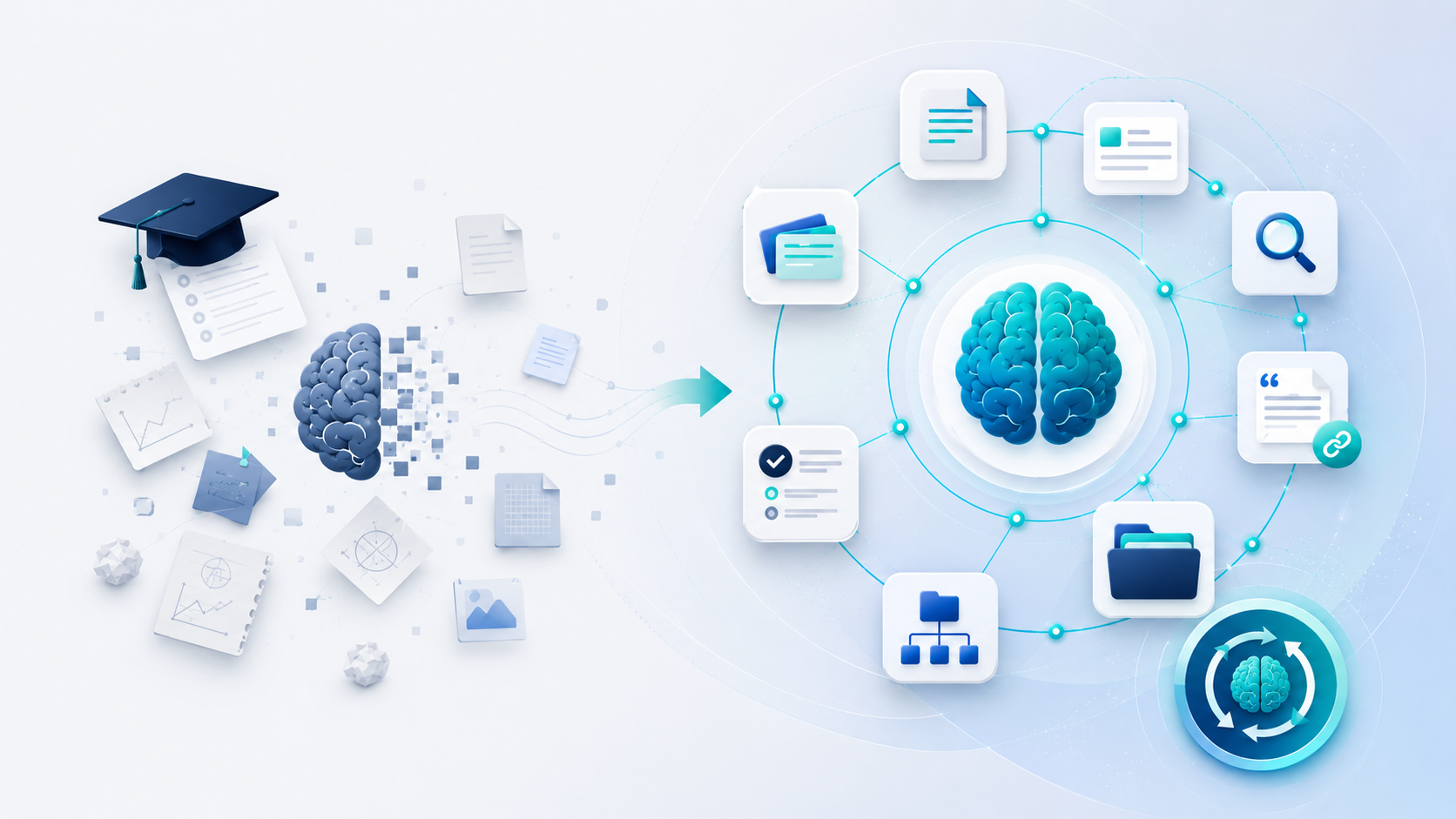
The practical implication is encouraging: forgetting can be slowed and retrieval can be strengthened. The aim is not to remember every sentence from every lecture. It is to preserve central concepts, useful evidence, disciplinary methods and the ability to rebuild detail when necessary.
Exams encourage short-term organisation
Students naturally direct effort towards what is rewarded. When an exam covers a twelve-week module, study materials are organised around that deadline. Flashcards are created, summaries are condensed, and practice questions are completed. Once the exam ends, the system loses its purpose.
This deadline-based model creates temporary knowledge containers. A folder is labelled by module, a revision deck is labelled by exam date, and a study timetable ends on the day of assessment. Nothing in the system prompts the student to revisit the most valuable ideas later.
The result is a series of isolated peaks of familiarity rather than cumulative expertise.
Cramming creates a feeling of fluency
Intensive rereading and last-minute review can make material feel easy because it has been encountered repeatedly in a short period. This feeling is sometimes mistaken for durable learning. The page looks familiar; the answer seems obvious when it is visible; the student can follow the explanation. However, recognising information is easier than generating it independently.
Research on test-enhanced learning showed that repeated retrieval can produce better long-term retention than repeated study. Further work on the critical importance of retrieval for learning found that once material had been successfully recalled, additional retrieval practice was more valuable for long-term retention than additional exposure.
This helps explain why knowledge can vanish after an exam. If revision depended mainly on seeing the material again, the student may have built familiarity without creating enough opportunities to retrieve and apply it.
Knowledge becomes trapped inside module boundaries
A student may learn about motivation in psychology, leadership in management and behaviour change in public health without connecting the three. Each module uses its own terminology, reading list and assessment. When the files are closed, the concepts remain separated.
Knowledge becomes more durable when it is connected to multiple cues. An idea linked to a case study, a personal example, another theory and an assignment argument has more routes for retrieval than a definition copied into one set of notes.
Concept mapping can help students make these relationships explicit. Research synthesised in a meta-analysis of concept and knowledge maps found that mapping can support learning when students actively identify meaningful links. A later meta-analysis on concept maps and academic achievement also reported positive effects across the studies it reviewed.
Notes are stored, not revisited
Digital storage creates a reassuring illusion: because the file exists, the knowledge is safe. In one sense, it is. In another, it has become inactive. Research on cognitive offloading describes how people use external tools to reduce memory demands. This can improve performance, but external storage changes what the mind needs to retain.
For students, the lesson is not to avoid notes. It is to distinguish between two goals:
- preserving information externally so it can be found;
- strengthening understanding internally so it can be used.
A knowledge system should support both. It should save the source and also generate opportunities to recall, explain and apply the idea.
Assessment can narrow the meaning of learning
When revision is guided entirely by predicted exam questions, students may learn the examinable surface of a topic while neglecting its wider significance. They memorise the strengths and weaknesses of a theory but do not consider where it appears in the world, how it relates to another discipline or when it might be useful professionally.
This is understandable under time pressure. However, it makes post-exam forgetting more likely because the knowledge has few contexts outside the assessment.
A simple solution is to add one transfer question to every major topic:
- Where else could this idea be used?
- What current problem does it help explain?
- How would it change a professional decision?
- What does it contradict from another module?
- What would count as evidence against it?
Transfer questions give the knowledge a life beyond the mark scheme.
Students rarely process feedback as knowledge
After an exam or assignment, feedback often receives less attention than the grade. Yet feedback contains knowledge about the student’s own learning: recurring weaknesses, effective strategies, misconceptions and expectations within the discipline.
Save feedback in a degree-wide record rather than leaving it inside each assessment portal. Group comments under categories such as argument, evidence, structure, method, referencing and clarity. Add one sentence describing what you will do differently next time.
This turns isolated comments into a personal model of academic improvement. It also prevents the same advice from arriving repeatedly without changing behaviour.
How to preserve knowledge after an exam
The period immediately after assessment is the best time to compress and reconnect learning. The material is still relatively accessible, and the student can see which topics mattered most.
1. Create a module legacy note
Write one document that answers:
- What was this module fundamentally about?
- Which ten ideas are worth keeping?
- Which sources or examples were most useful?
- What did I misunderstand at first?
- What can I now explain or do?
- Which later modules or career areas might use this knowledge?
Keep it short enough to revisit. This is not another full set of revision notes. It is a map back into the module.
2. Keep a small set of evergreen questions
Do not continue reviewing hundreds of exam flashcards. Select the questions that represent foundational knowledge. Review them at widening intervals and update them when your understanding changes.
Questions should require explanation, comparison or application rather than a single missing word. For example, “How does prospect theory challenge the assumptions of rational choice?” is more valuable than “Who developed prospect theory?”
3. Link the module to future work
Add links from the module to:
- related modules;
- dissertation ideas;
- placement or professional skills;
- methods you may use again;
- recurring authors or theories;
- unresolved questions.
These links create reasons for the knowledge to return.
4. Reuse knowledge in new outputs
The strongest review often occurs when knowledge is used for a new purpose. Explain the idea to a peer, apply it to a current case, compare it with a new reading or use it to critique a later theory. Retrieval becomes more durable when it is meaningful rather than mechanical.
5. Schedule light maintenance
A sustainable long-term review plan might include:
- a ten-minute revisit one month after the module;
- a short review at the beginning of the next academic year;
- a search for relevant past modules when starting a new assignment;
- an annual degree map showing how major concepts connect.
The purpose is not permanent revision. It is preventing valuable knowledge from becoming invisible.
Build a curriculum that belongs to you
Universities design official curricula, but every student also develops a personal curriculum. This includes the theories that changed how they think, the examples they remember, the methods they can use and the questions they continue to pursue.
A personal knowledge management system preserves this curriculum. It allows the student to organise information by meaning rather than only by timetable. Knowledge from first year can remain available in third year. A useful framework from one module can reappear in a dissertation. Feedback from several assignments can reveal a pattern that no single comment showed.
The process is closely related to self-regulated learning. A meta-analysis of university self-regulated learning programmes found improvements in academic performance, strategy use and motivation. Students benefit when they plan, monitor and adapt their learning rather than simply move from task to task.
How source-grounded AI can support continuity
AI study tools can help students revisit old material, but only when the system can show where its answers came from. Generic summaries may remove the module context or invent connections that are not supported by the student’s sources.
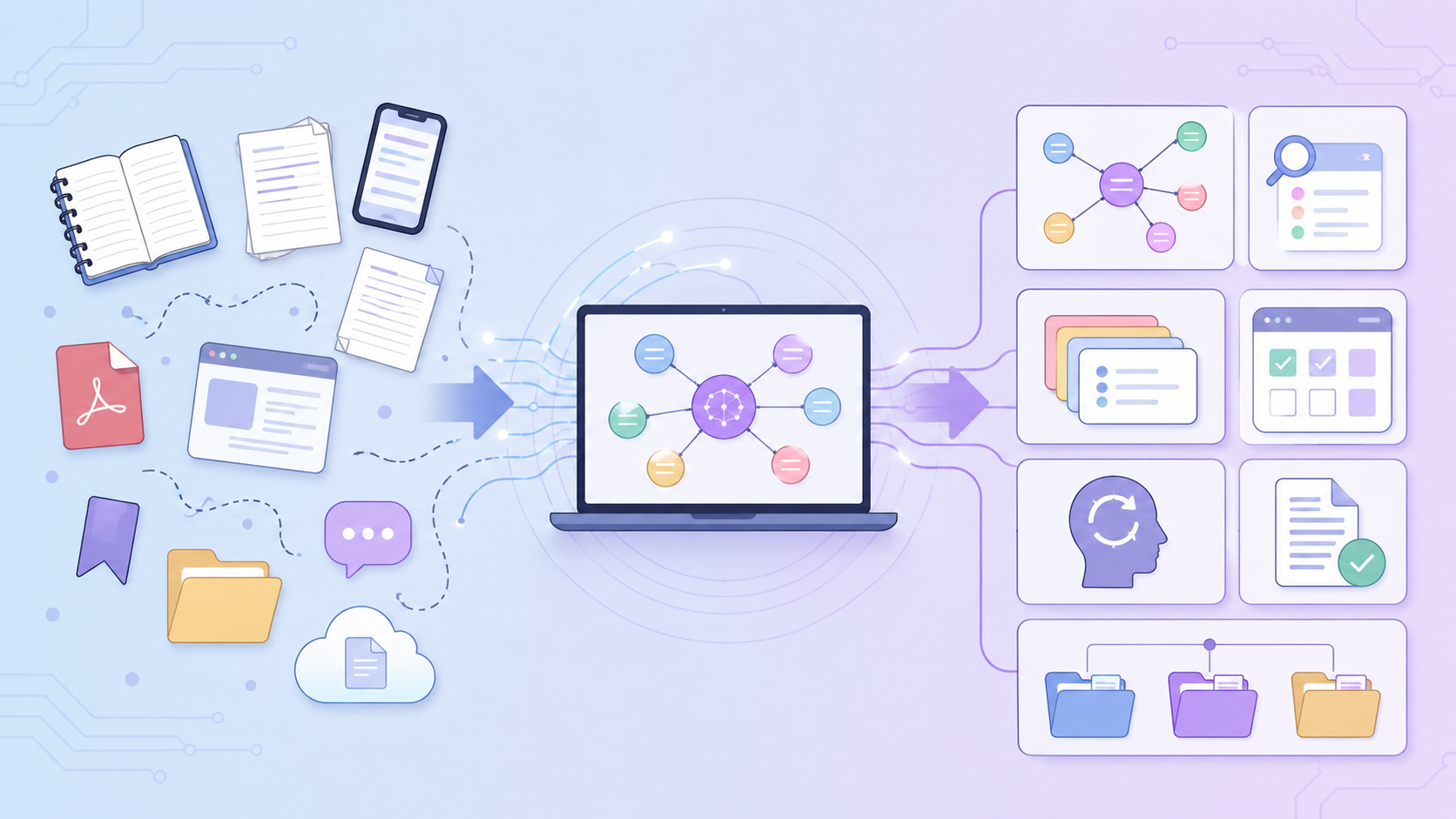
Learnd.Ai is built to help students work across their own learning content in a source-grounded environment. Lecture materials, readings and notes can be searched and turned into study resources while retaining a path back to the original source. This makes it easier to reactivate earlier learning without treating AI output as unquestionable truth.
The goal is not perfect memory
No student needs to remember every detail from every assessment. Long-term learning means retaining the structure of a subject: its central questions, core concepts, methods, evidence and relationships. It also means knowing how to return to the detail quickly.
Students lose valuable knowledge after exams because retrieval stops, notes remain isolated and the system is built around deadlines. The answer is not endless revision. It is a small set of habits that preserve the intellectual value of each module: create a legacy note, keep foundational questions, connect ideas across the degree and reuse knowledge in new contexts.
An exam should be a checkpoint in learning, not the point at which learning disappears.
Bring your learning materials into one organised, source-grounded space with Learnd.Ai.