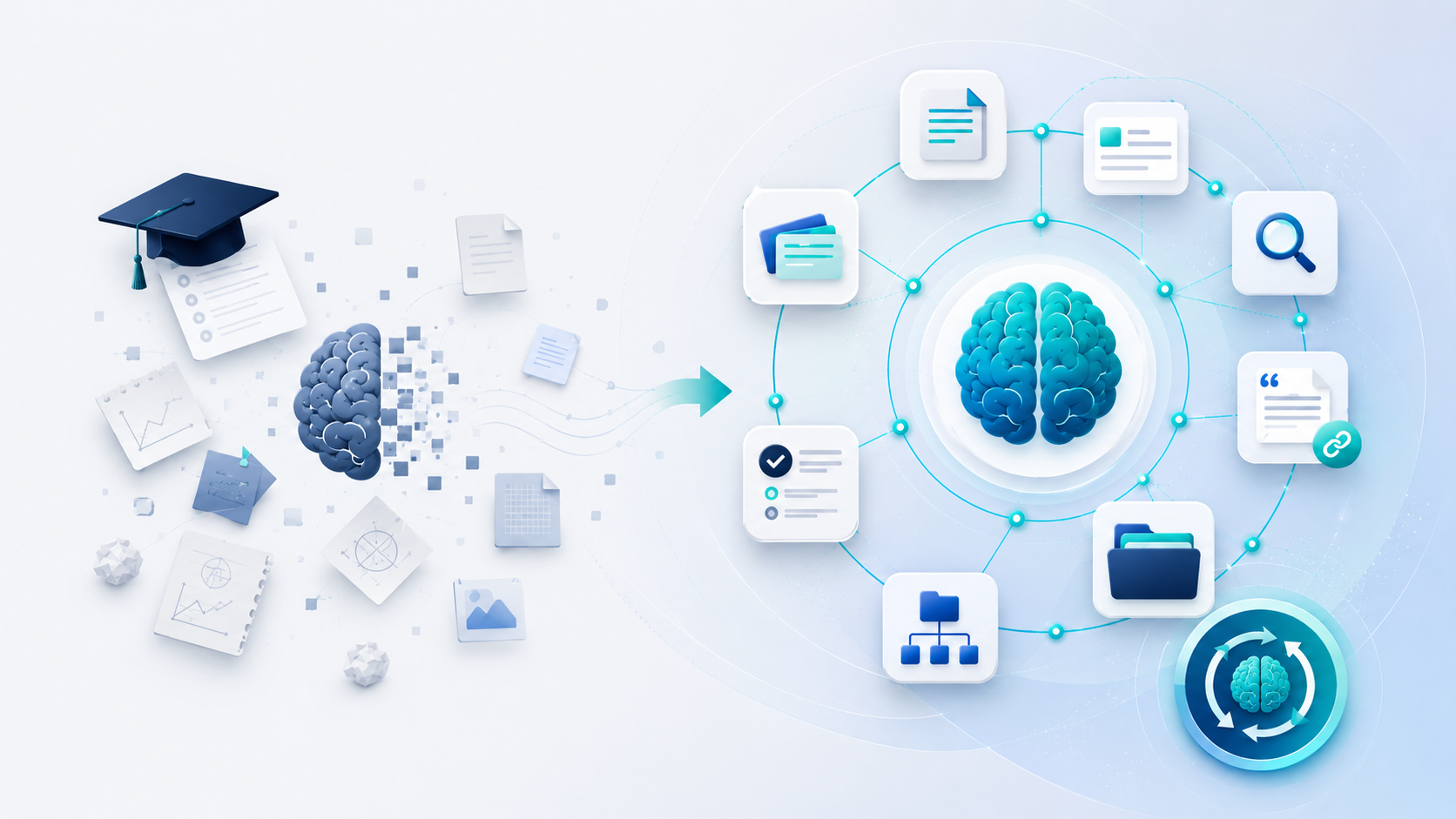


AI is now part of ordinary student life. The HEPI Student Generative AI Survey 2026 found that 95% of UK undergraduates use AI in at least one way, and 94% use generative AI to help with assessed work. Yet the same report captured two sharply different experiences. Some students said AI gave them more time for analysis and deeper understanding. Another described the effect more bluntly: they were no longer using their brain.
That contrast is the real issue. The question is no longer whether students should touch AI. It is whether the tool is doing work around learning or replacing the mental activity through which learning happens.
Used well, AI can organise scattered lectures, explain a difficult concept, turn notes into practice questions and help you identify gaps. Used badly, it can produce an instant answer that feels like progress while leaving very little behind. The goal is not to avoid all assistance. It is to protect the productive struggle that builds understanding, memory and judgement.
Dependence is not about how often you open an AI tool
A student can use AI every day without becoming intellectually dependent on it. Another student can use it once a week but hand over the most important parts of every task. Frequency is a poor measure. A better question is: which cognitive steps are you still performing yourself?
Psychologists use the term cognitive offloading for shifting part of a mental task into the environment. Writing a deadline in a calendar, saving an article in a reference manager and drawing a diagram are all forms of offloading. They can free attention for more demanding work. The problem begins when the tool does not merely hold information or reduce administration, but performs the interpretation, reasoning and retrieval that you need to practise.
Healthy assistance removes friction. Dependence removes capability. A useful study tool might transcribe a lecture so you can search it. An unhealthy pattern is asking the tool to tell you what the lecture means before you have tried to follow the argument. A useful tool might create ten quiz questions. An unhealthy pattern is revealing every answer before you attempt one.
<h4>The four-step rule: think, ask, verify, retrieve</h4>
A simple way to keep yourself in control is to structure every important AI interaction around four steps.
1. Think first. Write what you already know, attempt the problem, predict the answer or identify the exact point of confusion before asking for help.
2. Ask for targeted support. Request a hint, counterexample, explanation, comparison or set of questions rather than asking the tool to complete the whole task.
3. Verify against the source. Check the lecture, textbook, paper, marking criteria or official guidance. Treat fluent language as a presentation style, not evidence of truth.
4. Retrieve without assistance. Close the chat and explain the idea from memory, solve a new problem or answer a fresh question. If you cannot do that, the interaction produced temporary clarity rather than learning.
The final step matters most. Decades of learning-science research show that retrieving information strengthens long-term memory more effectively than simply seeing it again. Roediger and Karpicke’s work on test-enhanced learning and Rowland’s meta-analysis of testing versus restudy both support the value of effortful retrieval. LRND’s guide to active recall versus passive revision explains how to turn this evidence into a study habit.
Use AI to create the conditions for learning, not to imitate the result
A polished summary, essay plan or worked solution looks like the end product of learning. That makes it tempting to request the product and assume the learning will follow. Usually, the order needs to be reversed. Use AI to set up activities that require you to produce the result.
- Instead of asking, ‘Summarise this chapter for me’, ask for five questions that test the chapter’s central argument. Answer them before requesting feedback.
- Instead of asking, ‘Solve this equation’, show your attempted first step and ask where the reasoning went wrong.
- Instead of asking, ‘Write my essay structure’, draft your own structure and ask the tool to identify missing perspectives or weak transitions.
- Instead of asking, ‘Explain everything about this topic’, ask for a diagnostic quiz, then request explanations only for the concepts you missed.
- Instead of copying generated flashcards, edit them, remove vague cards and add examples from your lecturer’s material.
A study workspace such as LRND’s AI study platform is most useful when it converts your own materials into practice while keeping you in the loop. Uploading lectures, PDFs, recordings and notes can remove the manual work of organising a module. The student still needs to answer the questions, evaluate the explanations and return to weak areas.
Build a source-first habit
Generic chatbots can produce plausible answers from broad training data, but your course is defined by particular readings, definitions, methods and assessment expectations. An answer can be generally reasonable and still be wrong for your module.
Start with the source whenever the task is academic. Use your lecture slides, assigned papers, seminar notes and marking rubric as the boundary of the conversation. A cited AI tutor built from your own notes can make that easier by linking answers back to the relevant page or timestamp. Source grounding does not eliminate the need to check, but it makes checking possible.
Use citations actively rather than decoratively. Open the cited passage. Read the sentences before and after it. Confirm that the source supports the claim being made, not merely the topic. For important assignments, follow the trail to the original paper instead of citing an AI summary of it.
Protect the first attempt
The first attempt is often where the learning happens. It exposes what you can retrieve, where your reasoning breaks and which ideas you only recognise when they are in front of you. AI can erase that evidence by supplying an answer too early.
Create a small delay before using assistance. For a short question, give yourself two minutes. For an essay plan, spend fifteen minutes making a rough outline. For a quantitative problem, write down the known variables, formula and first transformation. The attempt does not need to be good. It needs to be yours.
Research on generative AI and mathematics offers a warning. In a large field experiment by Bastani and colleagues, access to a general-purpose AI assistant improved supported practice performance, but students who used it as a crutch performed worse when the assistance was removed. A version with educational guardrails reduced that harm. The lesson is not that AI inevitably damages learning. It is that tool design and usage sequence matter.
Ask for hints before answers
A good tutor does not always give the solution. It asks what you have tried, offers the next useful cue and adjusts the level of support. You can imitate that pattern in your prompts.
- ‘Do not give me the final answer. Ask me one question at a time that helps me find it.’
- ‘Here is my attempt. Identify the first incorrect step and give me a hint only.’
- ‘Test whether I understand this concept with three increasingly difficult questions.’
- ‘Give me two plausible misconceptions and ask me to explain why they are wrong.’
- ‘After I answer, compare my reasoning with the source and show exactly what I missed.’
This approach preserves agency. It also produces better diagnostic information. A completed answer tells you what the model can generate. A sequence of hints and student responses tells you what you understand.
Separate understanding mode from production mode
Students often move too quickly from reading to producing assessed work. AI makes that jump almost effortless, which is why it helps to separate two modes.
In understanding mode, the goal is to build a mental model. You ask for explanations, analogies, comparisons, examples and questions. You are allowed to be messy. You make notes in your own words and test whether you can reconstruct the argument.
In production mode, the goal is to communicate your own understanding within the assessment rules. You consult the brief, plan, draft, cite and edit. AI use should match the institution’s policy and the specific assessment instructions. A tool may be permitted for language feedback but prohibited for generating content. The boundary can vary by module, so check rather than assume.
The Russell Group principles on generative AI in education emphasise AI literacy, appropriate use, academic integrity and the need for staff and students to understand both opportunities and limitations. The most defensible habit is to document how you used the tool and retain your notes, drafts and source trail.
Turn every explanation into active recall
Explanations feel satisfying because confusion drops quickly. But reduced confusion is not the same as durable knowledge. After any useful explanation, create a retrieval task.
- Close the answer and write a three-sentence explanation from memory.
- Draw the process or relationship without looking.
- Generate a new example that follows the same principle.
- Answer a question in a different format, such as moving from multiple choice to short answer.
- Return to the idea the next day and again later in the week.
Spacing those attempts matters. Dunlosky and colleagues’ review of effective learning techniques rated practice testing and distributed practice among the highest-utility approaches. LRND’s spaced-repetition flashcards can automate the schedule, but the memory work still occurs when you attempt the answer before turning the card over.
Use AI to find weaknesses, not to hide them
A common dependence pattern is using AI to keep work looking smooth. It fills gaps, repairs reasoning and improves wording before you have seen where the underlying weaknesses are. For learning, those weaknesses are valuable data.
Ask the tool to be diagnostic. Request questions across the full topic, not only the parts you enjoy. Ask it to classify errors: missing knowledge, confused concepts, faulty procedure, weak evidence or careless execution. Keep an error log. Revisit the same type of mistake with a new example rather than merely correcting the original answer.
For exam preparation, an AI revision workflow that ends in timed mock exams is more protective than a workflow that ends with a summary. A mock exam removes conversational support and reveals whether you can retrieve and apply the material under realistic conditions.
Know the warning signs of overreliance
Dependence often develops gradually. Watch for changes in your behaviour rather than waiting for a dramatic failure.
- You feel unable to begin a task until you have asked AI what to do.
- You paste questions into a chatbot before reading the assigned material.
- You accept explanations because they sound clear, without checking the source.
- Your notes are mostly generated text that you have not rewritten, challenged or tested.
- You can follow an AI solution but cannot solve a similar problem alone.
- You become anxious when a tool is unavailable during revision or assessment.
- Your writing is polished, but you struggle to explain the argument aloud.
- You repeatedly ask for easier explanations without returning to the original terminology you will need in the exam.
One warning sign does not prove dependence. It is a prompt to redesign the workflow. Remove AI from the first attempt, increase closed-book practice and set specific periods in which you study without assistance.
A practical weekly AI study routine
A balanced routine can use AI frequently while keeping the student responsible for understanding and recall.
1. Capture. Add the week’s lectures, readings, slides and your own notes to a module. Keep the original sources, not only generated summaries.
2. Organise. Group material by topic and learning outcome. Ask AI to identify duplicated ideas, missing readings and unclear terminology.
3. Understand. Attempt a short explanation of each key concept, then use targeted questions to repair misunderstandings. Verify every important claim against the source.
4. Practise. Generate flashcards, short-answer questions, problem sets or case scenarios. Answer before viewing feedback.
5. Space. Schedule weak material to return across several days rather than repeating it in one sitting.
6. Simulate. Complete a timed, closed-book quiz or mock exam without AI assistance.
7. Reflect. Record which errors came from knowledge gaps, reasoning errors or misreading. Use AI to generate fresh practice for those exact weaknesses.
This is close to the capture-organise-understand-remember-retrieve loop described in the LRND story. AI supports the transitions between stages; it should not collapse the loop into ‘ask and copy’.
Examples across different subjects
In law, a dependent workflow asks for a complete case summary and memorises it. A stronger workflow reads the judgement, drafts the ratio and key facts, then asks a source-grounded tool to challenge omissions and generate a new problem question. LRND’s workspace for law students is designed around cases, statutes and lecture material in one citable module.
In engineering, a dependent workflow requests a worked solution immediately. A stronger workflow identifies the governing principle, attempts the setup and asks for the first incorrect step. It then solves a new variant without help. The engineering study workspace supports practice problems and cited explanations grounded in course material.
For a dissertation, a dependent workflow asks AI to write a literature review from a topic. A stronger workflow builds a verified reading set, writes source notes, asks questions across those papers and checks whether each claim in the draft has support. The dissertation and thesis revision workflow keeps papers, drafts and cited answers together.
What responsible independence looks like
The aim is not to prove that you can do every administrative task manually. Students have always used tools: books, calculators, search engines, spellcheckers and reference managers. Independence means retaining authorship of the important decisions.
You decide what the question requires. You decide which sources are credible. You attempt the reasoning. You judge whether the answer fits the evidence. You practise retrieval until the knowledge is available without the tool. You can explain what you submitted and how you arrived there.
AI can make studying more organised, responsive and active. The safest principle is simple: let it reduce the work around learning, but do not let it remove the work that is learning.
Frequently asked questions
Is using AI every day a sign of dependence?
No. Daily use can be healthy when the tool organises materials, generates practice and provides feedback while you still attempt, verify and retrieve independently. Dependence is better measured by which mental steps you have surrendered.
Should I avoid AI when I am learning a new topic?
Not necessarily. Start with the assigned source and your own first attempt. Then use AI for targeted explanations or questions. Avoid letting a generated summary become your only contact with the material.
Can I use AI to write an essay plan?
Follow the rules for that assessment. From a learning perspective, draft your own plan first and use AI to test its logic, coverage and counterarguments rather than generating the entire structure from nothing.
How can I tell whether I have actually learned something?
Close the tool and the notes. Explain the concept, answer a fresh question or solve a new problem. Repeat after a delay. Independent retrieval is a stronger test than whether an explanation felt clear.
What kind of AI tool is least likely to encourage blind trust?
Look for source grounding, precise citations, clear limits, controllable study activities and features that require active answers. A source-grounded AI learning platform should make verification and practice easier, not merely generate polished text.
Sources and further reading
- HEPI, Student Generative Artificial Intelligence Survey 2026 — https://www.hepi.ac.uk/reports/student-generative-ai-survey-2026/
- Risko and Gilbert, Cognitive Offloading, Trends in Cognitive Sciences, 2016 — https://pubmed.ncbi.nlm.nih.gov/27542527/
- Roediger and Karpicke, Test-Enhanced Learning, 2006 — https://psychnet.wustl.edu/memory/wp-content/uploads/2018/04/Roediger-Karpicke-2006_PPS.pdf
- Rowland, The Effect of Testing Versus Restudy on Retention, 2014 — https://pubmed.ncbi.nlm.nih.gov/25150680/
- Dunlosky et al., Improving Students’ Learning With Effective Learning Techniques, 2013 — https://www.whz.de/fileadmin/lehre/hochschuldidaktik/docs/dunloskiimprovingstudentlearning.pdf
- Bastani et al., Generative AI Without Guardrails Can Harm Learning — https://papers.ssrn.com/sol3/papers.cfm?abstract_id=4895486
- Russell Group, Principles on the Use of Generative AI Tools in Education — https://www.russellgroup.ac.uk/policy/policy-briefings/principles-use-generative-ai-tools-education
- UNESCO, Guidance for Generative AI in Education and Research — https://discovery.ucl.ac.uk/id/eprint/10176438/