

You have read the same chapter three times.
You have highlighted the important sentences, rewritten your notes and watched another video explaining the topic. The material now looks familiar. You feel as though you understand it.
Then you close your notes and try to explain the topic without looking.
Nothing comes out.
This does not necessarily mean you did not study for long enough. It may mean that most of your study time was spent reviewing information rather than practising how to retrieve it.
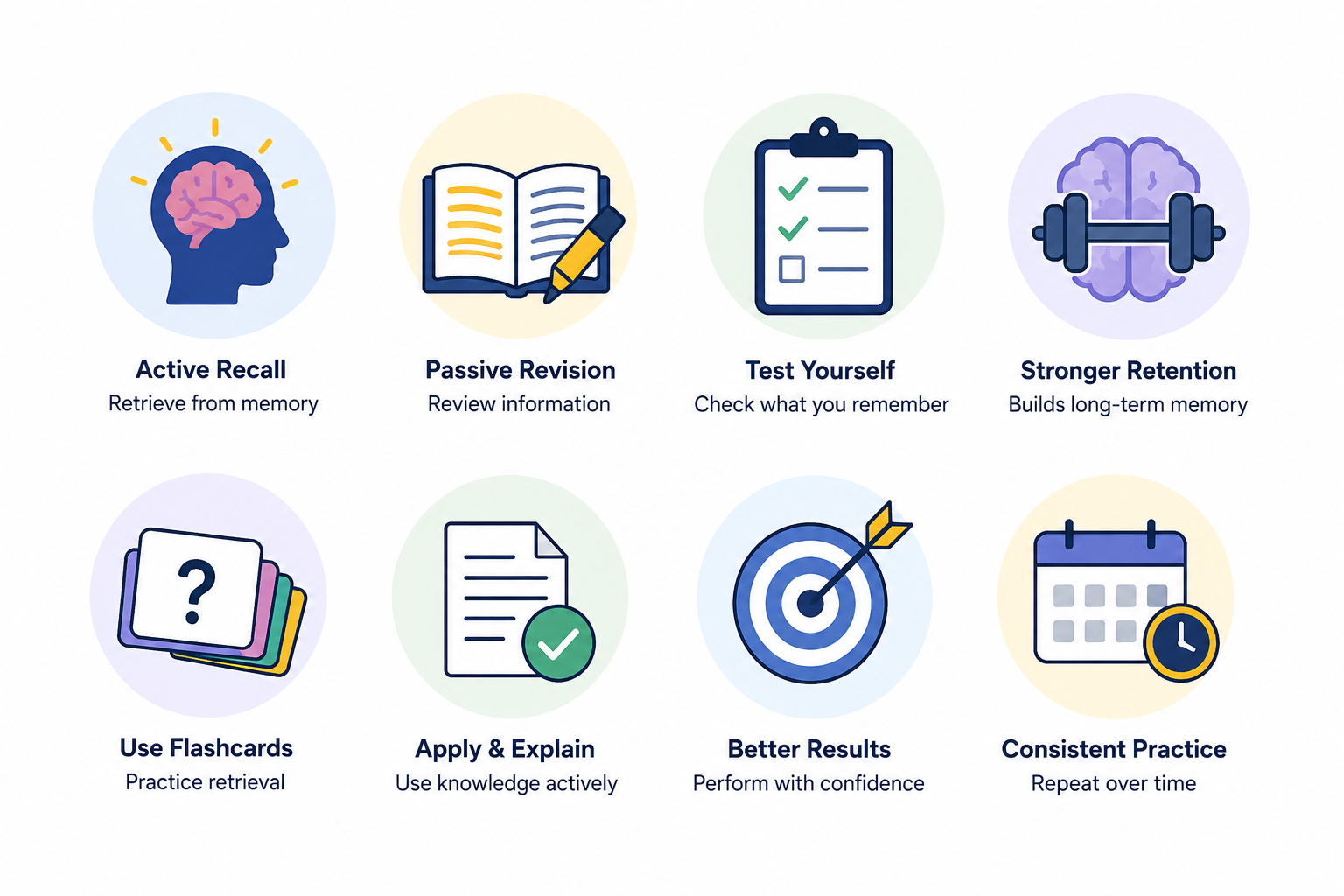
That is the central difference between active recall and passive revision.
Passive revision puts information in front of you. Active recall asks you to bring that information back from memory.
Both have a place in learning. Reading, listening and watching can help you encounter and understand new material. However, repeatedly seeing information does not guarantee that you will be able to recall it during an exam, use it in an assignment or apply it to a new problem.
Active recall tests whether the knowledge is still available when the textbook, lecturer, notes or AI-generated summary is no longer supplying the answer.
Active recall vs passive revision: the quick answer
Active recall is generally more effective than passive revision for long-term retention.
Active recall requires you to retrieve information from memory. Examples include:
- Answering practice questions
- Completing mock exams
- Explaining a topic without notes
- Using flashcards correctly
- Recreating diagrams from memory
- Writing closed-book summaries
- Solving problems independently
- Teaching a concept to someone else
Passive revision involves reviewing information while it remains visible. Examples include:
- Rereading notes
- Highlighting textbooks
- Copying definitions
- Rewatching lectures
- Reading summaries
- Looking through model answers
- Watching someone solve a problem
A classroom-focused meta-analysis combined evidence from 222 studies involving 48,478 students. It found that testing and quizzing improved academic achievement by a medium-sized amount overall [4].
The practical lesson is simple:
Do not judge your learning only by how familiar the material feels while it is open. Test what you can produce after you close it.
What is active recall?
Active recall is a learning method in which you deliberately retrieve information from memory before checking the answer.
You might answer a question, reconstruct a process, explain a theory, solve a problem, label a diagram or write everything you remember about a topic.
Active recall is closely related to terms such as:
- Retrieval practice
- Practice testing
- Test-enhanced learning
- Self-testing
- The testing effect
These terms are not always completely interchangeable in academic research, but they share an important principle: attempting to retrieve information can strengthen later learning.
Examples of active recall include:
- Answering a flashcard before turning it over
- Listing the causes of an event without checking your notes
- Explaining a scientific process aloud
- Writing an essay plan from memory
- Completing a past-paper question
- Solving a calculation without following a worked example
- Recreating a mind map on a blank page
- Predicting the next stage of a process
- Answering questions based on lecture materials
- Completing a timed mock exam
The tool itself does not determine whether the activity is active.
A flashcard app can be used passively if you reveal each answer immediately. A blank sheet of paper can support powerful retrieval practice if you use it to reconstruct an entire topic from memory.
What is passive revision?
Passive revision involves reviewing information with little attempt to retrieve, manipulate or apply it independently.
Common passive revision activities include:
- Reading lecture notes repeatedly
- Highlighting large sections of a textbook
- Copying information word for word
- Rewatching recorded lectures
- Reading completed summaries
- Looking at labelled diagrams
- Reviewing model answers
- Listening to an explanation
- Watching someone else solve a problem
- Asking AI to summarise a chapter and only reading the output
These activities are not automatically useless.
You cannot retrieve information you have never encountered. Reading, listening and watching are often necessary when you are first learning a topic.
The problem begins when passive review becomes the main or only revision method.
Rereading can tell you that a paragraph looks familiar. It cannot reliably tell you whether you will be able to reconstruct the argument tomorrow.
Highlighting can show you where an important definition appears. It cannot confirm that you can explain that definition without looking.
Watching a worked example may help you follow a method. It cannot prove that you can select and apply that method to a new problem.
LRND’s guide to why rereading notes does not work as well as it feels explores how familiarity can be mistaken for secure learning.
Is “passive recall” the correct term?
People often search for “active recall vs passive recall”, but passive revision or passive studying is more accurate.
Recall means retrieving information from memory. That process is active.
When you reread a page, recognise a term or look at a completed answer, you may not be recalling the information. You may simply be recognising something that is already visible.
This distinction matters because recognition and recall are not the same ability.
You may recognise the correct definition in a list but be unable to write it independently.
You may recognise the answer to a multiple-choice question but struggle to explain why it is correct.
You may understand each stage of a worked calculation while looking at it but be unable to begin a similar problem on your own.
Recognition asks:
Have I seen this before?
Recall asks:
Can I produce it without seeing it?
Most exams, presentations and real-world tasks eventually require the second ability.
Active recall vs passive revision: key differences
| Area | Active recall | Passive revision |
|---|---|---|
| Main action | Retrieving information | Reviewing information |
| Common methods | Practice questions, flashcards, mock exams and explanations | Rereading, highlighting, copying and rewatching |
| Mental effort | Usually higher | Usually lower |
| Immediate feeling | Often difficult | Often smooth and reassuring |
| Feedback | Reveals knowledge gaps | Can hide knowledge gaps |
| Long-term retention | Generally stronger | Generally weaker when used alone |
| Exam preparation | Practises producing and applying knowledge | Mainly builds familiarity |
| Best use | Retention, consolidation and application | Initial exposure and clarification |
| Main risk | Poor questions or missing feedback | Illusion of competence |
Why passive revision feels productive
Passive revision often feels effective because the material becomes easier to process each time you see it.
A paragraph that felt difficult during the first reading may feel obvious during the third. A diagram becomes recognisable. A lecturer’s explanation sounds familiar. You can move through your notes more quickly.
This growing ease can be confused with learning.
You may be becoming better at processing the information while it is present without becoming better at retrieving it when it is absent.
This produces an illusion of competence: the material feels known because it is familiar, even though it may not yet be independently retrievable.
A major review of ten widely used learning techniques rated practice testing and distributed practice as having high utility. Highlighting and rereading received lower utility ratings when used as standalone strategies [3].
This does not mean you should never reread.
It means rereading should usually lead to another activity:
Read a section for understanding.
Close the material.
Retrieve what you remember.
Check your response.
Correct what was missing.
Retrieve it again later.
What does research say about active recall?
Active recall is not simply a popular study trend. It is supported by decades of research into retrieval practice and test-enhanced learning.
The landmark retrieval-practice study
In a widely cited 2006 study, Henry Roediger and Jeffrey Karpicke asked students to study educational prose passages.
Some participants repeatedly studied the material. Others spent part of their learning time completing free-recall tests.
Repeated studying produced stronger performance when students were tested after only five minutes. However, after delays of two days and one week, students who had practised retrieval remembered substantially more [1].
The study highlighted an important difference between immediate performance and long-term learning.
A method can make you perform well during a study session without producing the strongest long-term retention.
Rereading may keep information accessible while it is still fresh. Retrieval practice prepares you to access it after a delay.
What the meta-analyses found
A 2014 meta-analysis examined testing compared with restudying and found an overall benefit for retrieval practice. It also found that initial recall tests tended to produce larger benefits than recognition-based tests, supporting the importance of effortful retrieval [2].
The 2021 classroom meta-analysis examined 222 independent studies involving 48,478 students. Testing or quizzing improved academic achievement by a medium-sized amount overall, with a reported effect size of g = 0.499 [4].
This is important because real classroom learning is more complicated than memorising isolated words in a laboratory.
- Students must often:
- Understand connected concepts
- Retain information for several weeks
- Apply knowledge to unfamiliar questions
- Combine content from different lessons
- Explain their reasoning
- Work under time pressure
The classroom findings suggest that retrieval practice can support learning in realistic educational settings, not only controlled experiments [4].
What recent research says
A 2024 systematic review investigated active-recall strategies and academic achievement in young adults. It found promising evidence for methods including practice testing, flashcards, retrieval practice and concept mapping, although the included studies varied in design and quality [5].
A 2025 study examined whether retrieval practice could support the retention and application of complex educational concepts. The researchers concluded that retrieval practice can benefit both retention and transfer, particularly when learners receive enough retrieval opportunities and learning is measured after a delay of several days [6].
Another 2025 study introduced retrieval practice into an ordinary primary-school environment. Fifth-grade students studied authentic history material, and retrieval practice with feedback outperformed simple rereading [7].
A 2025 state-of-the-art review also described the growing use of retrieval practice across medicine, nursing, dentistry and other health-professions education settings [8].
Together, these studies suggest that active recall can be useful across different ages, subjects and educational settings.
Does every study find an advantage?
No learning method works equally well under every condition.
A 2026 study reported two online experiments conducted through the crowdsourcing platform Prolific in which retrieval practice did not significantly outperform restudying on delayed tests [10].
The paper did not establish that the wider testing effect had disappeared. Instead, it showed why context and implementation matter.
Results can be influenced by:
- Learner engagement
- Cognitive load
- Task complexity
- Retrieval success
- Feedback
- Question quality
- Attention
- Alignment between practice and assessment
Active recall is not a magic instruction that works regardless of how it is applied.
Questions can be too vague, too difficult or poorly connected to the learning objective. Students may guess without thinking. Incorrect answers may go uncorrected. Learners may attempt retrieval before they have developed enough understanding to answer meaningfully.
The strongest conclusion is therefore not that every retrieval activity is automatically effective.
It is that well-designed retrieval practice generally produces stronger long-term learning than passive restudy alone [1, 2, 4].
Why active recall works
Researchers have proposed several explanations for the effectiveness of retrieval practice.
1. Retrieval strengthens access to knowledge
When you retrieve an idea, you practise finding a route back to it.
Learning does not only involve storing information. Knowledge must also remain accessible when it is needed.
Every successful retrieval gives you further practice accessing that knowledge. This is why answering a question can improve later retention rather than merely measure what you already know [1].
2. Retrieval exposes knowledge gaps
It is difficult to identify gaps while looking at a complete answer.
When your notes are open, every stage of a process can appear logical. When the notes are removed, missing definitions, weak connections and misunderstood steps become visible.
Suppose you are studying cellular respiration.
While reading, you may understand the explanation. When asked to reconstruct the process without looking, you may discover that you cannot remember:
- Where each stage occurs
- What enters each stage
- What is produced
- How the stages connect
- Why oxygen is important
The unsuccessful retrieval attempt gives you useful information.
Instead of rereading the entire chapter, you can focus on the precise information that was missing.
3. Retrieval improves your judgement of learning
Active recall provides clearer feedback than passive review.
You either produced the answer, partly produced it or could not produce it.
This helps you distinguish between:
- Knowledge you can retrieve securely
- Information you only recognise
- Ideas you partly understand
- Concepts you have misunderstood
- Material you have forgotten
Better awareness of your own knowledge makes revision more targeted.
4. Retrieval prepares you for exams
Most exams do not ask whether a page looks familiar.
They ask you to produce an answer after the source material has been removed.
Active recall makes revision more similar to that requirement.
For an essay-based assessment, retrieval practice might include generating arguments, recalling evidence and writing closed-book plans.
For a mathematical assessment, it might include selecting the correct method, recalling the formula and completing unfamiliar problems.
For a clinical or professional assessment, it might involve interpreting a scenario, retrieving the relevant principle and explaining how it applies.
5. Retrieval can support application
Active recall is sometimes dismissed as a method for memorising facts.
That depends on the questions being used.
“What is the definition of opportunity cost?” mainly tests a definition.
“How might opportunity cost influence a person deciding between full-time employment and university?” requires both retrieval and application.
The 2025 research on complex educational concepts found that sufficient retrieval practice could support retention and transfer to new questions [6].
Active recall can ask learners to:
- Remember a definition
- Explain a process
- Compare two theories
- Apply a principle
- Analyse a scenario
- Evaluate an argument
- Design a solution
The quality of the question shapes the quality of the thinking.
Does passive revision have a role?
Yes.
Passive methods are useful when you need to:
- Encounter a topic for the first time
- Understand new terminology
- Follow an unfamiliar process
- Build background knowledge
- Review a worked example
- Clarify a confusing explanation
- Correct a misconception
- Locate important information
You cannot retrieve knowledge that has not first been learned.
The problem is usually not the presence of passive study but the imbalance between input and retrieval.
A stronger learning cycle is:
Input → retrieval → feedback → correction → spaced retrieval → application
Passive study supplies the initial input. Active recall helps turn that input into knowledge that can be accessed later.
The best active recall techniques
There is no single technique that is best for every subject. The most useful method is one that matches what you will eventually need to do with the knowledge.
1. Closed-book brain dumping
A brain dump, sometimes called blurting, involves writing everything you remember about a topic without looking at your materials.
To use it:
- Choose a focused topic.
- Close your notes and textbook.
- Write everything you remember.
- Organise it into headings or stages.
- Compare it with the source.
- Identify missing or inaccurate information.
- Repeat the activity after a delay.
Brain dumping works well for processes, theories, historical events and broad topic reviews.
The purpose is not to create attractive notes. It is to expose gaps.
2. Question-first notes
Traditional notes often present information as statements.
For example:
Inflation is a sustained increase in the general price level.
Question-first notes turn the information into prompts:
What is inflation?
Why is a one-off increase in one product’s price not necessarily inflation?
How does demand-pull inflation develop?
How might inflation affect savers?
This gives you material that can be reused for retrieval instead of repeatedly reread.
Include different question types:
- Definitions
- Processes
- Comparisons
- Applications
- Causes and consequences
- Evaluations
- Exceptions
3. Flashcards
Flashcards support active recall when you attempt the answer before revealing it.
Useful flashcards should:
- Focus on one meaningful idea
- Have a clear, answerable question
- Include application as well as factual recall
- Be checked against reliable material
- Return over time
- Be removed when they are no longer useful
A card that asks “Explain economics” is too broad. A card asking “What are the three main functions of money?” is focused and checkable.
LRND’s AI flashcard generator creates source-linked, spaced-repetition flashcards from students’ PDFs, notes, slides and lecture recordings.
4. Practice questions and mock exams
Practice questions are especially useful because they can reflect the type of retrieval required by the final assessment.
They may test:
- Factual recall
- Explanation
- Interpretation
- Calculation
- Comparison
- Analysis
- Evaluation
- Application
After answering, do not simply mark the response correct or incorrect.
Ask:
- What knowledge was missing?
- Did I misunderstand the question?
- Could I recall the information but not apply it?
- Was my answer too vague?
- Did I miss an important step?
- What should I practise next?
LRND’s exam-revision workspace allows students to generate study plans, quizzes, flashcards and timed mock exams from their own materials.
5. Teaching the topic aloud
Explaining a topic without your notes requires you to retrieve and organise your knowledge.
Try explaining:
- What the concept means
- Why it matters
- How it works
- An example
- What it is commonly confused with
- Its limitations
- Where it can be applied
When your explanation becomes vague, you have probably found a gap.
6. Recreating diagrams
Diagram retrieval is useful for subjects involving structures, sequences or relationships.
You might reconstruct:
- A biological cell
- The human heart
- A chemical pathway
- A supply-and-demand graph
- A legal decision tree
- A computer architecture
- A historical timeline
Compare your version with the source and identify missing labels, relationships or stages.
7. Closed-book summaries
After reading a section, close the source and write a short summary containing:
- The central idea
- Important evidence
- Key stages
- Essential terminology
- Connections to other topics
- Unanswered questions
Then compare the summary with the original.
This combines retrieval, organisation and explanation.
Active recall and spaced repetition
Active recall and spaced repetition are related but different.
Active recall describes what you do: retrieve knowledge from memory.
Spaced repetition describes when you do it: return to the knowledge over time.
A combined cycle might look like this:
- Learn a concept.
- Retrieve it shortly afterwards.
- Check the answer.
- Retrieve it again the following day.
- Return to it several days later.
- Increase the interval when recall becomes reliable.
- Review it sooner when recall fails.
One correct answer does not guarantee permanent learning.
Knowledge becomes more durable when it is retrieved across different days and contexts. Practice testing and distributed practice were both rated highly in the influential review of learning techniques [3].
LRND’s guide to the science of long-term retention explains how retrieval, spacing and related learning principles work together.
How to turn passive revision into active recall
You do not need to abandon your existing study materials. Small changes can make common activities more retrieval-focused.
Instead of rereading a chapter
Read one section, close the book and answer:
- What was the main idea?
- What evidence supported it?
- What were the important stages?
- How did it connect to the previous section?
- What remains unclear?
Instead of highlighting
- Turn each important highlighted point into a question.
- Hide the original passage and answer the question from memory.
Instead of copying notes
- Read a short section, close the source and write the notes from memory.
- Then compare your version with the original.
Instead of rewatching an entire lecture
- Pause after each major section.
- Summarise the argument, list the key terms and predict what may come next.
Instead of repeatedly reading a model answer
- Hide it and create your own answer plan.
- Then compare the structure, evidence, reasoning and conclusion.
Instead of asking AI for a summary
Ask AI to:
- Question you before explaining
- Identify gaps in your answer
- Generate application scenarios
- Create a mock exam
- Compare your response with the source
- Return to incorrectly answered questions
How AI can support active recall
AI can either reduce thinking or support it.
Passive AI use includes prompts such as:
- “Give me the answer.”
- “Write my essay plan.”
- “Complete these questions.”
- “Summarise everything for me.”
These prompts may support initial comprehension, but the AI performs much of the work.
More active prompts include:
- “Ask me one question at a time.”
- “Do not reveal the answer until I respond.”
- “Ask me to explain my reasoning.”
- “Create application questions from this lecture.”
- “Return to the concepts I answered incorrectly.”
- “Challenge my explanation using the source material.”
A 2025 preprint studied LLM-generated retrieval questions in two university data-science courses involving approximately 60 students. Students achieved higher average assessment accuracy during the retrieval-practice condition, but the researchers also warned that AI-generated questions varied in quality and required manual review [9].
The result is promising but should not be treated as definitive evidence that every AI-generated quiz improves learning.
Questions still need to be accurate, relevant, appropriately difficult and grounded in trusted source material.
LRND’s AI study platform keeps flashcards, quizzes, mock exams, summaries, mind maps and a cited AI tutor connected to the student’s own learning materials.
Why organisation matters
Students’ knowledge is often spread across:
- Lecture slides
- PDFs
- Recordings
- Reading lists
- Personal notes
- Videos
- Assignments
- Browser tabs
- Different AI conversations
- Multiple revision apps
A student may revise one topic successfully but struggle to reconnect it to the wider module.
Long-term learning requires more than generating one temporary set of flashcards. Students need to return to, connect and retrieve knowledge across weeks, assessments and modules.
A student second brain keeps lectures, notes, readings and revision activities within a persistent knowledge system, making material easier to retrieve later.
Common active recall mistakes
Revealing the answer too quickly
Pause and make a genuine attempt before checking.
Using questions that are too broad
“Explain biology” is vague. “What are the stages of mitosis?” is focused.
Testing before building basic understanding
Begin with enough instruction to create a basic mental model, then introduce retrieval early.
Memorising disconnected facts
Include questions about relationships, mechanisms, applications and limitations.
Practising only easy questions
Gradually introduce more difficult and unfamiliar examples.
Practising only impossible questions
Retrieval should be effortful but achievable. Add a cue or reduce the scope when necessary.
Skipping feedback
Incorrect answers need to be checked and corrected. The 2025 primary-school study used retrieval with feedback and found stronger learning than rereading [7].
Using identical wording every time
Vary the context, question format and direction of recall.
Spending more time creating resources than using them
A simple question set that you answer is more valuable than a beautiful revision system you never practise.
Treating one correct answer as permanent mastery
Return to the question after a delay and test it again.
A practical seven-day active-recall plan
Day 1: learn and retrieve
Study the topic for understanding. Then close the material and write a summary or diagram from memory.
Day 2: focused questions
Answer five to ten questions without notes. Check and correct each answer.
Day 3: application
Complete questions that require you to apply the knowledge to a new example.
Day 4: mixed practice
Combine the topic with questions from an earlier topic.
Day 5: explanation
Teach the concept aloud, including examples and limitations.
Day 6: timed practice
Complete a short mock assessment without assistance.
Day 7: diagnose
- Review your mistakes and classify them:
- Forgotten knowledge
- Partial understanding
- Application error
- Misreading
- Weak explanation
- Time-management problem
Use this diagnosis to plan the next review.
Frequently asked questions
Is active recall better than passive revision?
Active recall is generally more effective for long-term retention because it requires learners to retrieve information rather than simply review it [1, 2, 4].
Passive revision remains useful for initial understanding, but it should usually be followed by self-testing, explanation or application.
Is highlighting active recall?
No. Highlighting mainly identifies important information.
It becomes part of active recall when you hide the highlighted content and attempt to explain it from memory.
Are flashcards active recall?
Flashcards support active recall when you answer before revealing the other side.
Reading both sides without attempting the answer is passive review.
Is active recall only useful for memorisation?
No. Questions can require explanation, comparison, analysis, evaluation and application.
Research on complex educational concepts suggests that sufficient retrieval practice can support retention and transfer [6].
Is active recall useful for mathematics?
Yes. Students can retrieve formulas, identify the correct method, explain why it applies and solve unfamiliar problems independently.
What should I do when I cannot remember an answer?
Make a genuine attempt, check the correct answer, identify what was missing and try again later.
Failure is useful when it leads to feedback and correction.
Is active recall the same as spaced repetition?
No. Active recall is retrieving information. Spaced repetition is revisiting it over time.
They are often most useful when combined.
Can AI help with active recall?
Yes. AI can generate questions, provide feedback and create application scenarios.
It is most useful when it asks the student to respond before revealing the answer and remains grounded in trustworthy course materials.
What is the best active-recall technique?
There is no single best method.
Practice questions, flashcards, closed-book summaries, diagrams, explanations and mock exams are all useful when they match the final assessment.
Final takeaway
Passive revision asks:
Does this information look familiar?
Active recall asks:
Can I produce and use this knowledge without looking?
The second question is harder.
It is also closer to what exams, professional practice and real-world problem-solving eventually require.
Rereading can help you understand a page.
Highlighting can help you locate an important idea.
A summary can help you organise information.
But learning becomes more durable when you repeatedly practise bringing knowledge back.
Read when you need input.
Retrieve when you want the learning to stay.
Research sources
- Roediger, H. L., and Karpicke, J. D. Test-Enhanced Learning: Taking Memory Tests Improves Long-Term Retention. Psychological Science, 2006.
- Rowland, C. A. The Effect of Testing Versus Restudy on Retention: A Meta-Analytic Review of the Testing Effect. Psychological Bulletin, 2014.
- Dunlosky, J., et al. Improving Students’ Learning With Effective Learning Techniques. Psychological Science in the Public Interest, 2013.
- Yang, C., Luo, L., Vadillo, M. A., Yu, R., and Shanks, D. R. Testing (Quizzing) Boosts Classroom Learning: A Systematic and Meta-Analytic Review. Psychological Bulletin, 2021.
- Xu, J., et al. Active Recall Strategies Associated With Academic Achievement in Young Adults: A Systematic Review. Journal of Affective Disorders, 2024.
- Corral, D., and Carpenter, S. K. Effects of Retrieval Practice on Retention and Application of Complex Educational Concepts. Learning and Instruction, 2025.
- Franzoi, L., Cembrani, V., Mulatti, C., and Treccani, B. Retrieval Practice Enhances Learning in Real Primary School Settings, Whether Distributed or Not. Frontiers in Psychology, 2025.
- Serra, M. J. The Use of Retrieval Practice in the Health Professions. 2025.
- An, Y., Liu, J., Acharya, N., and Hashmi, R. Enhancing Student Learning With LLM-Generated Retrieval Practice Questions: An Empirical Study in Data Science Courses. Preprint, 2025.
- Sigayret, K., Parmentier, J.-F., and Silvestre, F. Testing the Testing Effect on Prolific: When Retrieval Practice Fails to Boost Learning. Frontiers in Psychology, 2026.