
Most AI tools look similar from the outside. You type a question into a box, wait a few seconds and receive a fluent response. That visual similarity can make a general-purpose chatbot and an education-specific, source-grounded study tool seem interchangeable. They are not.
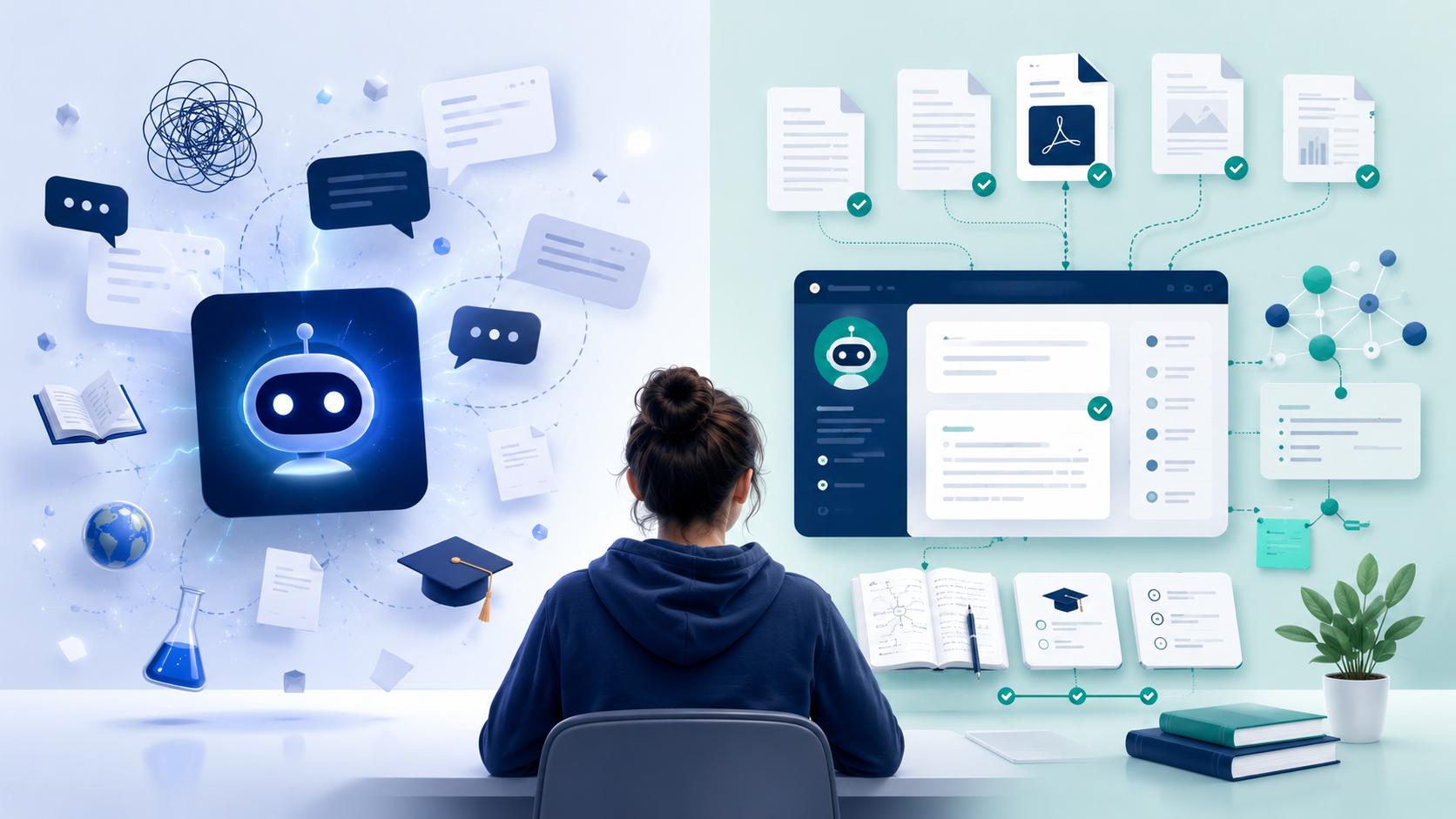
A generic chatbot is designed to respond across an enormous range of topics. A source-grounded tool is designed to answer within a defined body of material, such as your lecture recordings, PDFs, slides, reading list and notes. The difference affects what the tool knows, how you can verify it, how closely it follows your syllabus and whether it helps you build a reliable study system.
This matters because AI use in higher education is already near universal. According to the HEPI Student Generative AI Survey 2026, 95% of UK undergraduates use AI in at least one way. As use becomes routine, students need to judge tools by more than speed and writing quality.
What is a generic AI chatbot?
A generic AI chatbot is built to generate responses based on patterns learned during broad training and the context provided in the current conversation. It can explain common concepts, brainstorm, rewrite, translate, code and answer questions across many domains. That breadth is useful. It is also the reason the tool may not know what your lecturer taught, which edition of a textbook your module uses or how a particular concept was defined in your seminar.
When the model lacks reliable evidence, it does not necessarily stop. Language models are optimised to produce plausible continuations. They can state an outdated fact, merge two ideas, invent a citation or confidently answer a question whose correct response should have been ‘I do not know’. The tone may remain polished even when the content is wrong.
A generic chatbot can sometimes browse or accept an uploaded file. Those features can improve usefulness, but they do not automatically turn every answer into a source-grounded one. Students should ask what material was actually retrieved, whether the answer is restricted to it and whether the citation points to a precise supporting passage.
What is a source-grounded AI study tool?
A source-grounded AI study tool retrieves relevant information from a defined collection before generating an answer. In a student context, that collection might be one module containing lectures, slide decks, papers, notes, videos and web links. The response is constructed with that retrieved context rather than relying only on the model’s general training.
The technical family behind many of these systems is commonly called retrieval-augmented generation, or RAG. The foundational RAG paper by Lewis and colleagues described systems that combine a language model’s parametric memory with retrieved external documents. In plain English, the model is given relevant evidence at answer time instead of being expected to recall everything from training.
LRND applies this idea to study materials. It’s AI tutor from notes and course material answers from the sources a student adds to a module and links back to the page or timestamp behind the response. The purpose is not merely to make the answer sound academic; it is to make the evidence visible.
The first difference: the knowledge boundary
A generic chatbot’s knowledge boundary is broad and often unclear. It may draw on general patterns, conversation context, optional web results and any file you have attached. That can be useful for open-ended exploration, but it can also cause drift.
A source-grounded study tool has a narrower, intentional boundary. If you ask about week six of your economics module, the relevant answer should come from week six materials and any connected readings. If the information is absent, the tool should make that limitation visible rather than silently filling the gap from unrelated sources.
Narrower is not always better. A broad chatbot may be more helpful when you want general background, creative examples or perspectives beyond the syllabus. For exam revision, however, a defined boundary is often an advantage. Students are usually assessed on a particular curriculum, terminology and evidence base.
The second difference: citations and traceability
A citation is useful only when it allows you to trace a claim back to evidence. Generic chatbots may provide references, but those references can be incomplete, irrelevant or fabricated. In a study published in Scientific Reports, Walters and Wilder examined bibliographic citations generated by ChatGPT and found substantial rates of fabricated and erroneous references, especially in the weaker model tested.
Source-grounded tools should work differently. Instead of asking the model to remember a paper title, the system retrieves a passage that already exists in the student’s source set and attaches the answer to that passage. The best educational citations are precise: a PDF page, slide, timestamp, document section or quoted excerpt.
Precision changes student behaviour. A broad link to a 90-page document technically counts as a citation, but it leaves the student with most of the verification work. A timestamp that opens the relevant part of a lecture makes verification part of the normal study flow.
The third difference: alignment with the course
Two textbooks can use different notation. Two lecturers can frame the same debate differently. A medical programme may follow a local protocol. A law module may focus on a particular jurisdiction and set of cases. Generic answers can be accurate in a broad sense but misaligned with the course.
Source grounding reduces that mismatch because the system works from the material actually being taught. In the LRND engineering study workspace, for example, practice problems and explanations can be based on the techniques, derivations and past problem styles in the student’s own module. In the law student workspace, cases, statutes and lecture notes can remain within one searchable knowledge base.
Course alignment does not mean students should never look beyond assigned material. Wider reading is central to higher education. The point is to make the boundary explicit. A tool should distinguish ‘this is what your source says’ from ‘this is additional general context’.
The fourth difference: what the tool is designed to help you do
Generic chatbots are conversation engines. They are excellent at generating a response to the next prompt. Study tools should support a longer learning process.
That process includes capturing material, organising it by module, understanding difficult ideas, remembering them over time and retrieving them under assessment conditions. A chat answer may support one moment in that process, but it is not the whole system.
A purpose-built AI study platform can connect the same sources to summaries, notes, glossaries, flashcards, quizzes, mind maps, study plans and mock exams. The value is continuity. A concept explained in the tutor can reappear as a flashcard, then as a quiz question, then as a topic in a timed mock exam.
This distinction is easy to miss. A generic chatbot can generate a quiz if asked. The difference is whether the quiz remains tied to the module, carries citations, feeds a review schedule and contributes to a record of weak topics.
The fifth difference: memory and organisation across a course
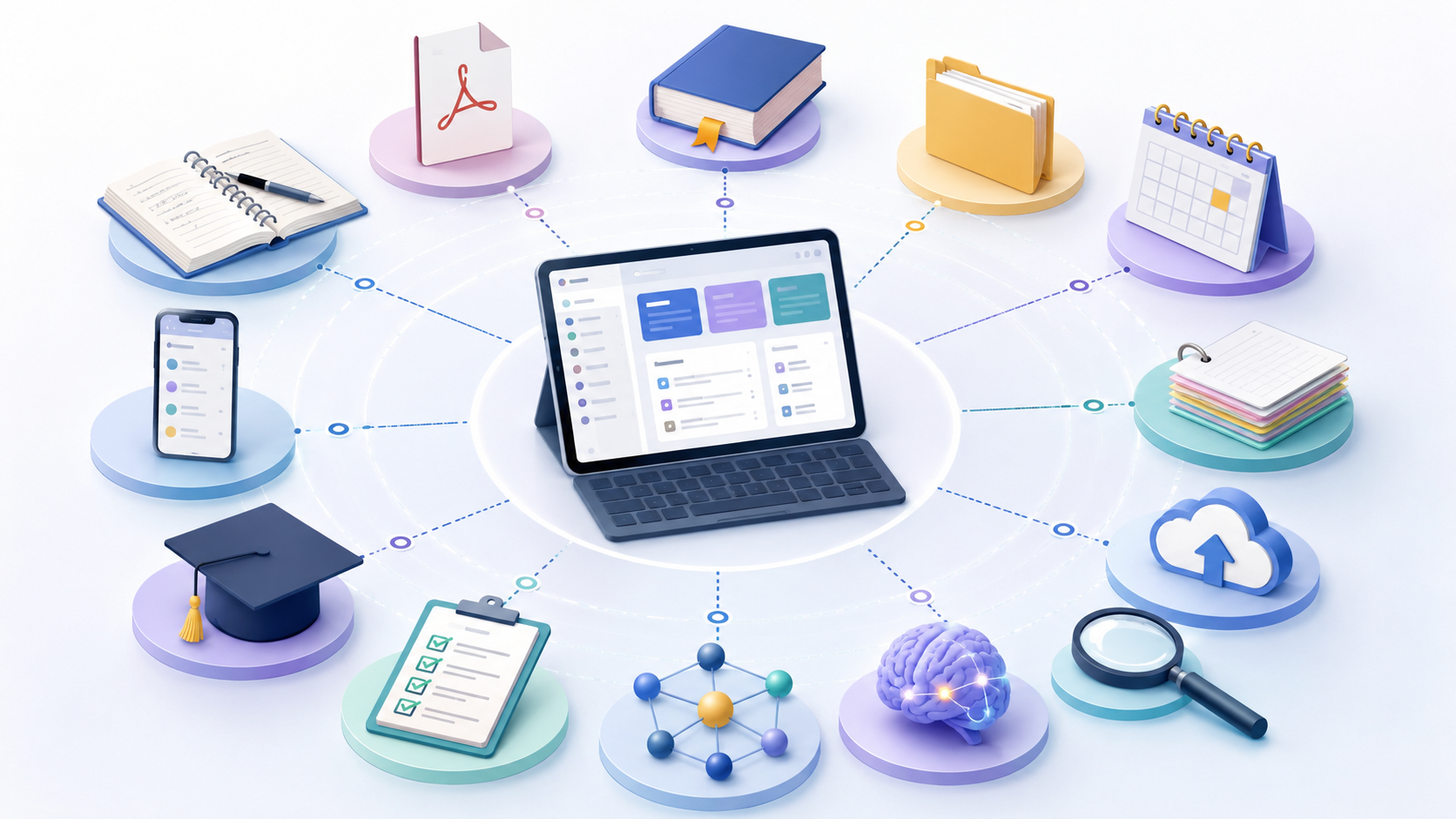
Students rarely suffer from a shortage of information. They suffer from fragmentation. The lecture is in one platform, slides in another, notes in a document, reading in a browser and revision questions somewhere else. A generic chat thread can add another temporary location.
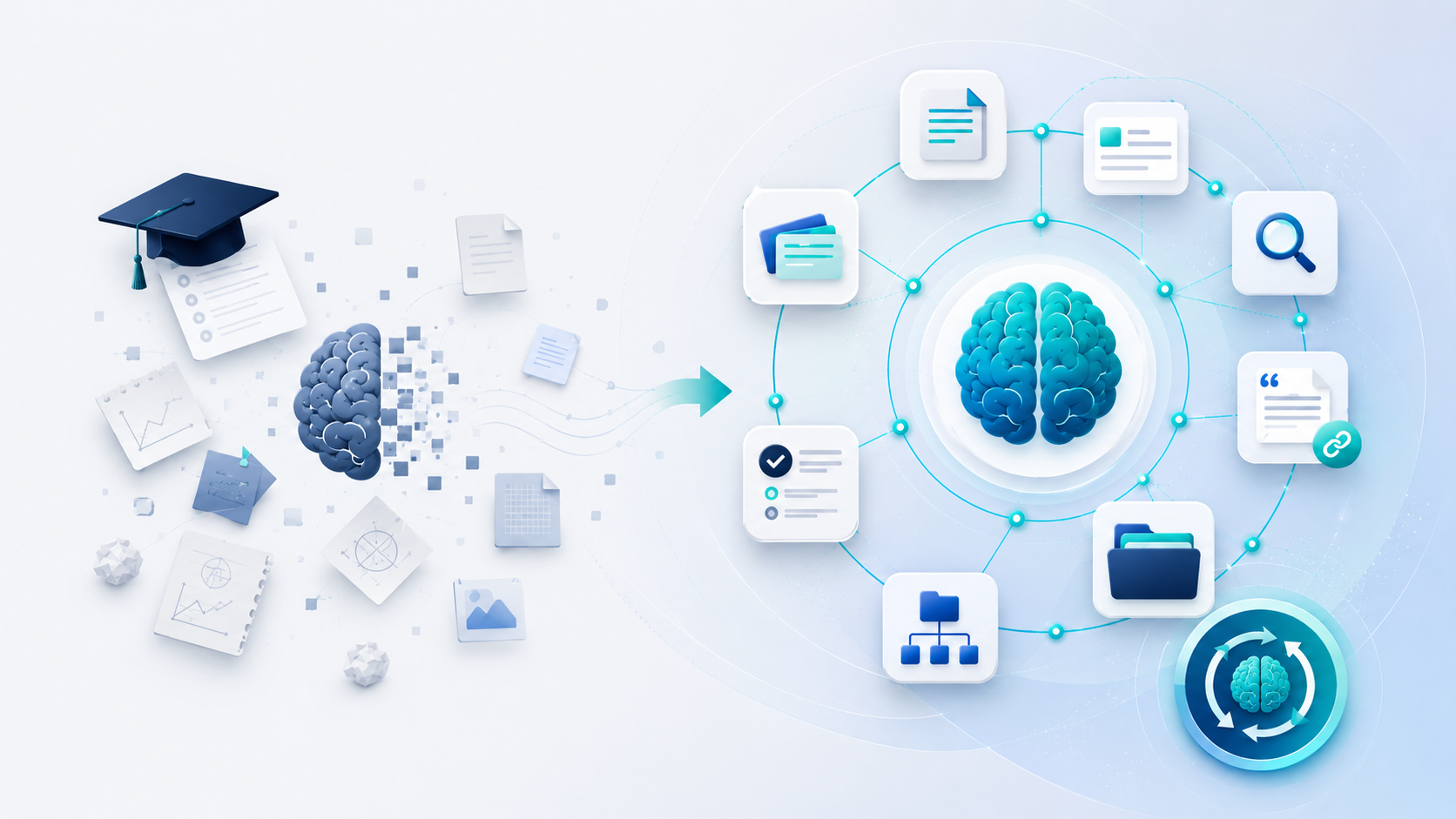
A source-grounded study workspace treats the module as a persistent knowledge environment. Sources remain searchable. Generated assets stay connected to the material. The student can return weeks later and ask where a concept first appeared, compare explanations across lectures or generate revision for a defined section.
LRND’s research organisation use case shows how papers, articles and reading lists can sit in one module with a cited tutor. The revision notes generator creates editable notes from recordings, slide decks and PDFs while keeping the source trail.
The sixth difference: privacy and institutional control
Students often paste course material, draft work and personal information into general AI services without checking how data is stored or used. Universities also have obligations around student data, intellectual property, accessibility, procurement and security.
Responsible implementation requires more than choosing a model. UNESCO’s guidance for generative AI in education and research calls for data protection, human agency, inclusion and validation of tools for ethical and pedagogical appropriateness. NIST’s Generative AI Profile similarly frames governance as an ongoing process of identifying, measuring and managing risks.
An institutional platform can provide clearer boundaries: approved source collections, defined retention rules, role-based access, guardrails, monitoring and integration with existing systems. LRND’s platform for institutions is positioned around transforming institutional material into secure, source-grounded learning environments while allowing academic and technology teams to retain control.
A side-by-side practical comparison
- Question: ‘What did my lecturer say about consideration in contract law?’ A generic chatbot may explain the general doctrine. A source-grounded tool should retrieve the relevant lecture and cite the exact slide or timestamp.
- Question: ‘Create revision cards for this module.’ A generic chatbot may generate broad cards from the prompt. A study tool should use the uploaded materials, cite each card and schedule difficult cards to return.
- Question: ‘Which topic am I weakest at?’ A generic chatbot only knows what appears in the current conversation. A study platform can use quiz and mock-exam history to identify repeated errors.
- Question: ‘Can I trust this reference?’ A generic chatbot may repeat or reformat a citation. A grounded tool should show the original source passage and still encourage independent verification.
- Question: ‘Help me prepare for Friday’s exam.’ A generic chatbot may create a generic timetable. A study platform can combine the actual exam date, available hours, module content and topic performance.
Source grounding reduces risk, but it does not create certainty
Grounded AI can still fail. Retrieval may select the wrong passage. A scan may be poorly parsed. The source itself may contain an error. The model may misinterpret a table or combine two passages incorrectly. A citation can point to a relevant page without fully supporting the claim.
The right promise is not ‘hallucination-free’. It is ‘more constrained, more transparent and easier to check’. Students should remain responsible for important claims, calculations and references.
Good systems make uncertainty visible. They distinguish between direct evidence and inference, show which sources were used, allow the student to open the original, and admit when the module does not contain enough information.
How to evaluate whether a tool is genuinely source-grounded
1. Upload a document containing an unusual fact or invented term. Ask a precise question and confirm that the answer points to the correct location.
2. Ask a question that the document does not answer. The tool should say the information is missing rather than inventing a response.
3. Upload two sources that disagree. Check whether the tool represents both positions and cites them separately.
4. Ask for a quote. Confirm that the wording appears exactly in the source and has not been paraphrased as a quotation.
5. Ask the same question at module level and single-source level. A robust tool should respect the selected scope.
6. Open the citations. Do they lead to a useful page, slide or timestamp, or merely to the document’s cover?
7. Check whether generated flashcards, notes and quizzes also retain citations. Grounding should extend beyond the chat feature.
When a generic chatbot is still useful
This comparison is not an argument that generic chatbots have no place in study. They can be useful for brainstorming everyday examples, practising a language conversation, improving the clarity of a sentence, exploring alternative explanations or obtaining broad background before deeper reading.
The safest choice depends on the task. For low-stakes exploration, breadth may be helpful. For claims about a module, revision assets, dissertation evidence and assessment preparation, traceability becomes more important.
Students can also combine the two approaches. Use a grounded workspace for course knowledge and a broad chatbot for clearly labelled external exploration. Do not let the second source silently overwrite the first.
Why the distinction matters for learning, not only accuracy
Source grounding changes the learning relationship. It encourages students to move between answer and evidence. It makes disagreement visible. It supports questions such as ‘where did this come from?’ and ‘what did I misunderstand?’ Those are academic habits, not merely technical features.
It also makes active study easier. Once a module is structured, the same content can become spaced-repetition flashcards, a glossary, a set of practice questions or a timed exam revision sequence. The student spends less time copying material between tools and more time retrieving and applying it.
What universities should ask vendors
- What sources can the system ingest, and how accurately are pages, timestamps, formulas and tables parsed?
- Does the model answer only from approved material, or can it blend in open-web content without clear labelling?
- How are citations generated and evaluated?
- What happens when the evidence is missing or conflicting?
- Are uploaded materials used to train models? How long are they retained, and where are they hosted?
- Can institutions configure guardrails, roles, branding, integrations and acceptable-use messages?
- Can academic teams review outputs and usage patterns without creating intrusive surveillance?
- Does the product support learning activities beyond chat, including retrieval practice and assessment preparation?
The QAA’s generative AI resources and Russell Group principles both point institutions towards a balanced approach that supports beneficial use while protecting academic standards. Procurement should therefore evaluate pedagogy, governance and evidence—not only model capability.
The clearest way to remember the difference
A generic chatbot begins with the model and waits for you to supply enough context. A source-grounded study tool begins with the student’s or institution’s knowledge base and uses the model to help work with it.
One is primarily a conversation with a broad AI. The other should be a learning environment in which answers, notes, questions and revision activities remain connected to evidence. Both can be useful. They should not be trusted in the same way or used for the same jobs.
Frequently asked questions
Does uploading a PDF to a chatbot make it source-grounded?
Not automatically. Check whether every answer is actually retrieved from the file, whether the tool respects the selected scope and whether citations point to exact supporting passages.
Can a source-grounded tool still hallucinate?
Yes. It can retrieve the wrong material or misinterpret the evidence. Grounding reduces open-ended guessing and improves traceability; it does not remove the need for verification.
Are citations enough to prove an answer is correct?
No. Open the citation and check whether it supports the precise claim. A relevant source is not always supporting evidence.
Which type is better for exam revision?
A source-grounded tool is usually better when the exam follows specific course material. Look for active-recall features, timed practice and topic-level feedback rather than summaries alone.
What makes LRND different from a general chatbot?
LRND organises a student’s own lectures, PDFs, recordings, slides and notes into modules, then uses those materials for a cited tutor and connected study assets such as flashcards, quizzes, mock exams, mind maps and study plans.
Sources and further reading
- Lewis et al., Retrieval-Augmented Generation for Knowledge-Intensive NLP Tasks, 2020 — https://arxiv.org/abs/2005.11401
- Walters and Wilder, Fabrication and Errors in Bibliographic Citations Generated by ChatGPT, 2023 — https://www.nature.com/articles/s41598-023-41032-5
- HEPI, Student Generative Artificial Intelligence Survey 2026 — https://www.hepi.ac.uk/reports/student-generative-ai-survey-2026/
- UNESCO, Guidance for Generative AI in Education and Research — https://discovery.ucl.ac.uk/id/eprint/10176438/
- NIST, AI Risk Management Framework: Generative AI Profile — https://www.nist.gov/publications/artificial-intelligence-risk-management-framework-generative-artificial-intelligence
- QAA, Advice and Resources on Generative AI — https://www.qaa.ac.uk/sector-resources/generative-artificial-intelligence/qaa-advice-and-resources
- Russell Group, Principles on the Use of Generative AI Tools in Education — https://www.russellgroup.ac.uk/policy/policy-briefings/principles-use-generative-ai-tools-education